
Massachusetts has not banned cryptocurrency kiosks. A bill that would, S.3048, has sat in the Senate Committee on Ways and Means since April 15, and the measure now carries a date. The Boston Herald reported on Nov. 29 that the legislation “needs to be passed and signed into law by Jan. 5.”
If that does not happen, the bill dies with the 194th General Court and has to be refiled from scratch in the next session. Nothing changes for the machines in the meantime. They still operate in gas stations and convenience stores across the state, and the attorney general still has no kiosk-specific statute to enforce against them.
The bill is called “An Act to stop cryptocurrency ATM misuse,” or the “SCAM” Act. It runs a few pages. What it does is narrower and harsher than the licensing bills that have passed in other states, and the enforcement clause reaches one party that most crypto legislation leaves alone: the landlord.
What S.3048 Would Do
The bill text inserts a new Chapter 167K into the General Laws, placed right after Chapter 167J. Its operative sentence takes one line: “A virtual currency kiosk operator may not operate a virtual currency kiosk in the commonwealth of Massachusetts.”
The definition covers the hardware people actually use: “an electronic terminal acting as a mechanical agent of the virtual currency kiosk operator to enable the virtual currency kiosk operator to facilitate the exchange of virtual currency for money, bank credit, or other virtual currency.” It reaches machines that route orders to a separate exchange and machines that draw on crypto the operator already holds.
The bill does not license kiosks, cap their fees, require receipts, or mandate a refund window. It prohibits the business. A state that enacts it would have no legal kiosk operator rather than a supervised one, a different outcome from the fee-cap and daily-limit statutes passed elsewhere.
The published text also runs from Section 2 straight to Section 4. There is no Section 3 in the version posted on the legislature’s site, which is the kind of gap that gets cleaned up in a redraft if the bill ever reaches the floor.
The Landlord Is Named in the Enforcement Clause
A violation is treated as a violation of Chapter 93A, the state’s consumer protection law, and the attorney general can bring the action. The bill lists who can be sued: the operator, and, second, “the owner of the premises on which the virtual currency kiosk is located, if the owner knowingly or intentionally permitted the virtual currency kiosk to be on the premises.”
That second defendant changes the economics of hosting a machine. A convenience store that takes a monthly fee for floor space would have to weigh that fee against consumer protection exposure, and the “knowingly or intentionally permitted” standard puts the question of what the owner knew at the center of any case.
The remedies go past a fine. If a court finds a knowing or intentional violation, it may order the operator to forfeit “the amount of any charges that were collected by the person from users of the virtual currency kiosks” during the unlawful period, forfeit any kiosk the operator owns and keeps in Massachusetts, and pay the attorney general’s investigation costs. Section 4 sets the effective date at passage, with no transition period for machines already installed.
None of that money is routed to victims. The forfeiture runs to charges and hardware and the state’s costs. The text creates no restitution fund, no claims process, and no deadline for anyone who lost money at a kiosk to recover it.
The Numbers Behind the Push
The FBI’s Internet Crime Complaint Center published its 2025 Internet Crime Report with a line item for this exact business: “Cryptocurrency ATMs/Kiosks 13,460 Complaints; $389 million in Losses.”
Three calculations from that line set the scale. Losses per complaint average about $28,900. Complaints average roughly 37 a day across the year. And kiosk losses equal about 3.4% of the $11.37 billion the same report attributes to all cryptocurrency-related complaints, a share that is small in dollars and large in the number of people filing.
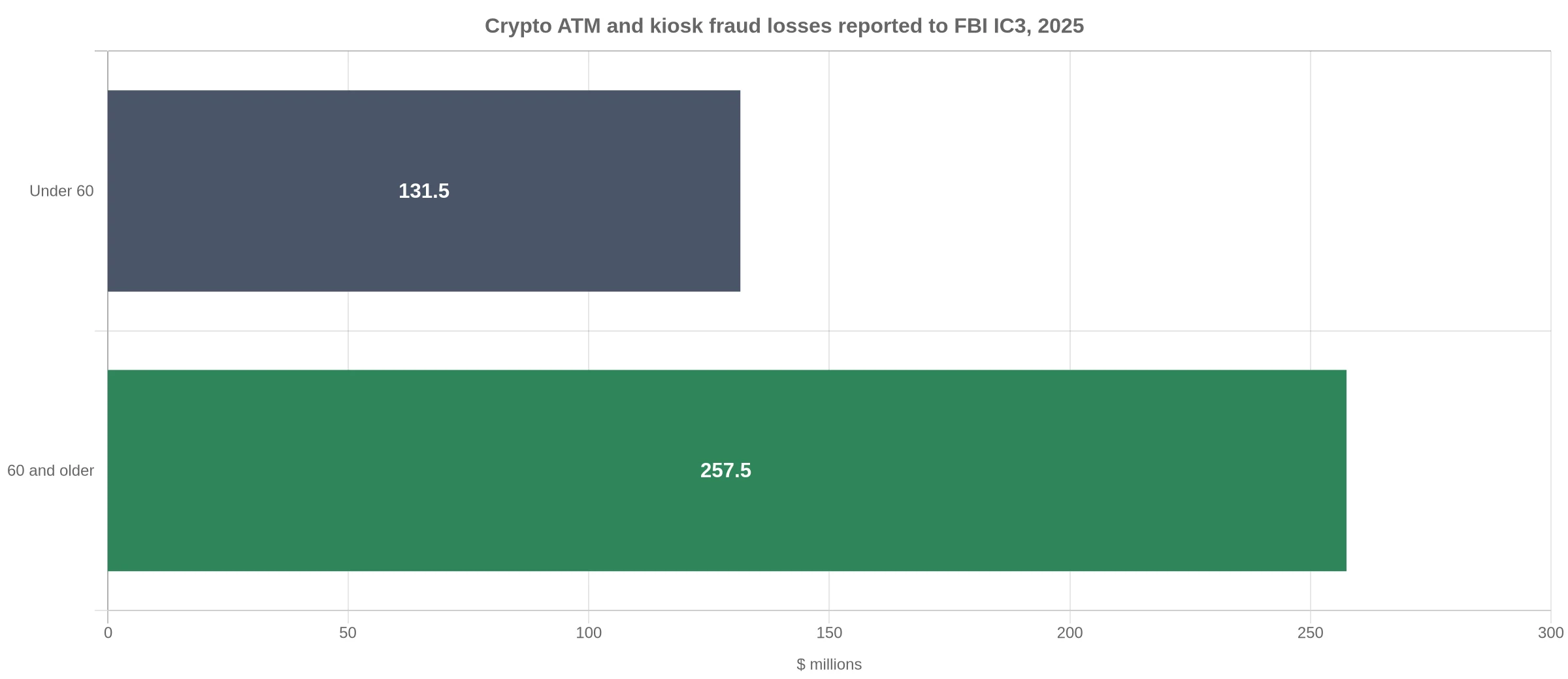
The age split is the sharpest figure in the report. Complaints from people 60 and older accounted for 6,188 filings and $257,466,130 in losses. That is 46% of the complaints and 66.2% of the money, an average of about $41,600 per older complainant against roughly $18,100 for everyone else.
From Two Petitions to One Bill, Then Silence
S.3048 did not start as S.3048. Two petitions were filed in the Senate: S.707 from John J. Cronin, Joanne M. Comerford, Peter J. Durant, Patricia D. Jehlen and other members, and S.757 from Barry R. Finegold. The Joint Committee on Financial Services merged them into a new draft on April 15, 2026, and sent it to Senate Ways and Means the same day.
The bill history on the legislature’s site lists three actions, all dated April 15: reported from Financial Services, identified as a new draft of S.707 and S.757, and referred to Ways and Means. Nothing follows. That is 228 days without a recorded vote, a hearing notice, or a floor debate.
Ways and Means is where bills with fiscal consequences land by default, and a ban with forfeiture and enforcement costs qualifies. The committee can release the bill, rewrite it, or let the calendar close on it.
Why Jan. 5 Is the Real Deadline
Massachusetts legislates in two-year cycles. The 194th General Court convened in January 2025, and its work ends before the next one is sworn in on Jan. 6, 2027, the first Wednesday of the year. Legislation that has not cleared both chambers and reached the governor’s desk by then does not carry over.
For a bill that has not moved in seven months, the remaining path is steep. Two chambers, three readings in each, a conference committee if the branches produce different texts, and a signature, all inside a stretch of the calendar that includes the holiday recess.
What a Ban Would Not Touch
Buying crypto on a licensed exchange, holding it in a self-custody wallet, and transferring it to another person are outside this bill. So is the state’s money transmission licensing framework, which is the regime most kiosk operators point to when asked what authorizes them to take cash today. The bill removes a physical distribution channel. It does not regulate the asset.
It also would not stop the fraud pattern that produced the IC3 numbers, at least not on its own. The scam usually starts on a phone or a dating app and ends at a machine that accepts cash, and the same instructions can be pointed at an out-of-state kiosk, a gift card rack, or a bank branch. Enforcement history in this area runs through settlements and seizures rather than statute: the Coinme kiosk shutdown in a $2.5 million multi-state settlement and the $938 million in scam-linked crypto that US authorities restrained both moved money without a state ban in place.
What to Watch Before the Session Ends
Three signals decide whether this becomes law in this session. First, whether Ways and Means releases S.3048 before the recess, since a bill that stays in committee cannot be voted on. Second, whether an amendment replaces the ban with a licensing or fee-cap regime, the route several other states took. Third, whether the 195th General Court refiles the text in January, which would reset the clock and the bill number.
For anyone who operates a kiosk, hosts one, or has a family member who uses one, the practical status is unchanged this week. The machines are legal today. The bill that would end them is one committee action away from a floor vote and one calendar year away from expiring.
Frequently Asked Questions
No. No kiosk-specific ban has been enacted. Operators work under the state’s general money transmission rules, and S.3048, the bill that would prohibit kiosks outright, has been in Senate Ways and Means since April 15, 2026.
It bars anyone from operating a virtual currency kiosk in Massachusetts and makes a violation a Chapter 93A consumer protection violation. The attorney general could sue the operator and a premises owner who knowingly or intentionally allowed the machine on site, and a court could order forfeiture of collected charges, forfeiture of the machines, and payment of investigation costs.
The Boston Herald reported on Nov. 29, 2026 that the bill must be passed and signed by Jan. 5, 2027. The 194th General Court’s work ends before the next General Court convenes on Jan. 6, 2027, and bills that have not been enacted by then must be refiled.
No. It covers physical virtual currency kiosks. Buying, holding, and transferring crypto through exchanges or self-custody wallets is outside its text, and the state’s money transmission licensing framework is left in place.
The bill does not create a restitution process. Forfeited charges and machines go to the state, along with investigation costs. Recovery for victims has come through separate enforcement actions and settlements, not through this statute.
Disclosure: This article does not represent investment advice. The content and materials featured on this page are for educational purposes only.
The post Massachusetts Wrote a Crypto Kiosk Ban in April. It Has Until Jan. 5 to Pass appeared first on Blockchainreporter .