
The European Banking Authority put a number on DeFi’s dependence on stablecoins on 25 November: 37 e-money tokens are authorised under MiCA, no asset-referenced tokens are, and the lending pools that do the volume run on a handful of dollar tokens that sit partly outside the rulebook that is supposed to govern them.
The finding comes in a 21-page report , EBA/Rep/2026/22, that examines how e-money tokens (EMTs) and other selected stablecoins are used in decentralised finance. Its most consequential line is not about size. It is about yield: MiCA bans issuers and crypto-asset service providers from paying interest on EMTs and ARTs, yet the EBA says some CASPs are marketing DeFi access as a way to earn on exactly those tokens.
The authority stopped short of proposing rules of its own. It repeated a recommendation first made in its September response to the European Commission’s MiCA consultation, and said it will keep monitoring through 2027. For now the document is evidence, not law. The EBA announced the publication in its own press release on the same day.
What the EBA actually published
The report is the second stage of work the EBA began with ESMA in 2024. That earlier MiCA review response found DeFi to be a niche with few EU users and asked Brussels to look at crypto lending. This time the authority went into the protocols themselves, sampling six blockchains (Ethereum, Tron, Solana, BNB Smart Chain, Base and Hyperliquid L1), four decentralised exchanges (Uniswap, Aerodrome, PancakeSwap, Hyperliquid) and six lending markets (Aave, Morpho, Fluid, Spark, Compound, JustLend).
It looked for two things: where MiCA-authorised tokens are actually used, and how EU users reach stablecoins that have no authorisation at all. Both answers are lopsided.
The report’s own framing of scale is deliberately modest. “Although DeFi is a relatively small segment of the overall crypto-asset market (the value of assets locked on DeFi represent around 3% of the total crypto-asset market capitalisation), and EU user engagement remains limited, DeFi is becoming increasingly accessible.” That accessibility is the point: the EBA names CASP interfaces, structured products and AI agents as the three channels closing the technical gap between a retail client and a lending contract.
A $75 billion pool inside a $2.5 trillion market
DeFi total value locked halved from its autumn 2025 peak to $75 billion by July 2026, the report says, citing DeFiLlama, CoinMarketCap and the EBA’s own calculations. Read that against the 3% share and the implied total crypto market capitalisation is roughly $2.5 trillion, an arithmetic step the report leaves to the reader.
Lending tells a different story from TVL. Active DeFi loans were $9 billion at the start of 2024, passed $50 billion in September 2025 and stood at $26 billion on 30 July 2026. The level is 48% below the peak, using the report’s own figures, but still 2.9 times the 2024 starting point. Collateral values fell faster than borrow demand, in other words, and the report attributes part of the earlier contraction to a bitcoin price correction and a record run of security incidents rather than to regulation.
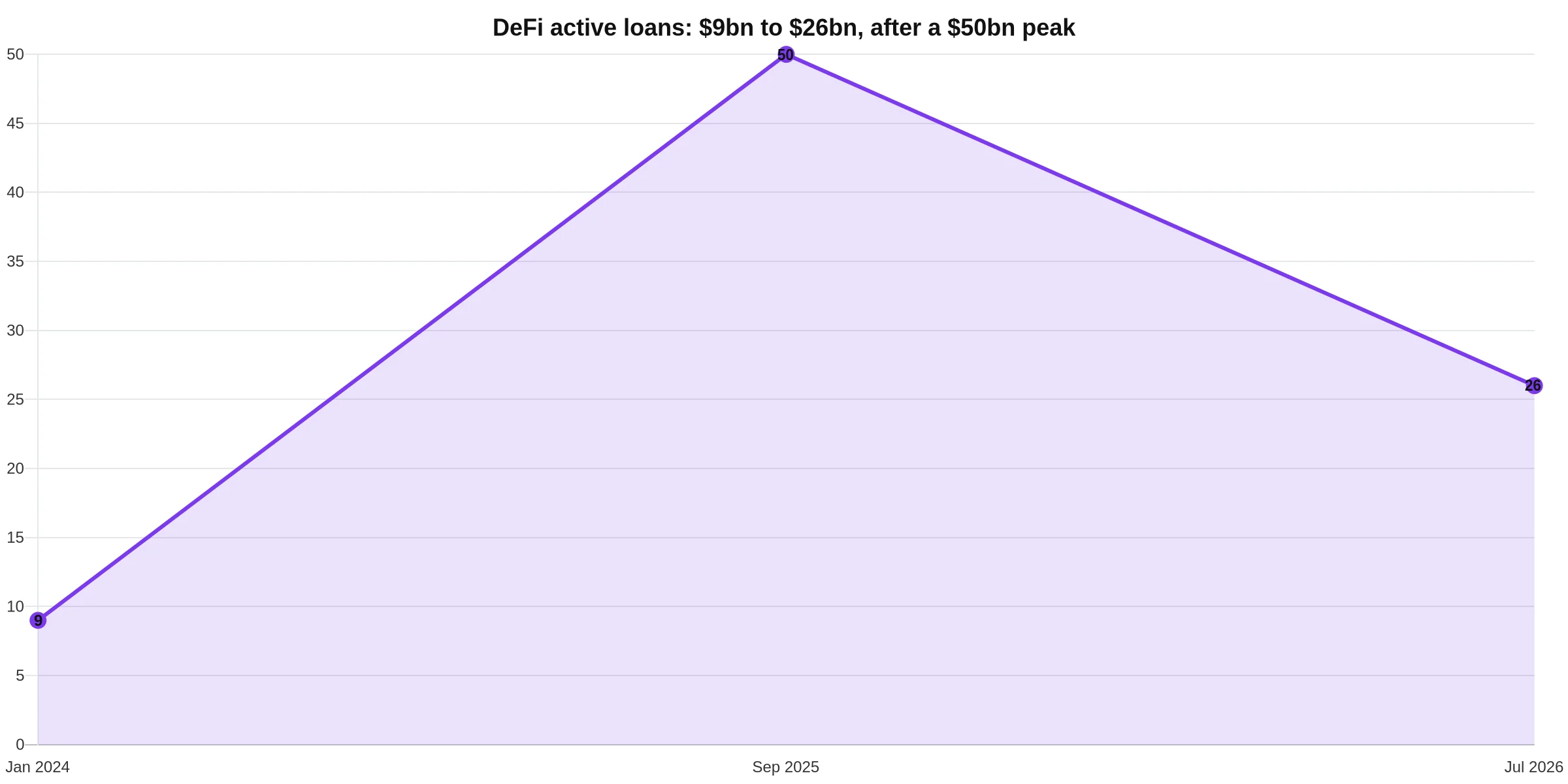
Supervisors care about that mix because loans are mostly denominated in stablecoins while the collateral is mostly volatile crypto. The report describes the structure plainly: users deposit volatile assets, borrow stable assets, and redeploy them to amplify positions. That is leverage on a stablecoin rail.
USDC is the collateral; USDT is the volume
Among MiCA-authorised tokens, USDC dominates. Classified as the EU’s first significant e-money token in October 2026, it is also the most borrowed EMT across the sampled lending protocols: with a market capitalisation of $73 billion in July 2026, it accounts for roughly a quarter of tokens borrowed on Aave and Fluid and about half on Morpho and Compound.
Applied to the $26 billion of active loans, that puts USDC borrow demand somewhere between $6.5 billion and $13 billion, with about $9.75 billion at the midpoint of the EBA’s own range. The report does not produce that figure, and the split varies by protocol and by day.
The smaller authorised tokens show how thin the MiCA perimeter still is in DeFi. USDG carries a $3.25 billion market cap and concentrates its DeFi activity on Uniswap. EURC is a $435 million token that ranks sixth by trading volume among reserve-backed stablecoins on Uniswap and second on Aerodrome, yet represents less than 0.1% of active loans on Aave. SG Forge’s EURCV, at $145 million, has more than half of its circulating supply parked in a single Morpho vault. Monerium’s EURe, at $33 million, has 40% of supply lent out on Aave.
Outside the perimeter the concentration is starker. Tether’s USDT, with a $184 billion market cap and no MiCA authorisation, is the most demanded stablecoin on Aave, Fluid and Spark, and $884 billion of it has traded on Uniswap year to date. Ethena’s USDe, down to $4 billion from $14 billion in September 2025, still has about $600 million of active loans on Aave. PayPal’s PYUSD is the second most lent token on Morpho at roughly 10%, and Ripple’s RLUSD accounts for 6% of Morpho’s active loans, about $241 million.
The EBA’s read on that gap is blunt. The 2026 ADAN survey it cites finds USDT held by 15% of surveyed individuals in Western Europe, “notwithstanding that its offer to the public in the EU is prohibited (as no authorisation has been sought under MiCA)”.
Where the interest ban leaks
MiCA stops issuers and CASPs from paying interest on EMTs and ARTs. It does not reach activity carried out in a fully decentralised manner. The EBA’s report argues that the space between those two sentences is where the rule loses force.
“Although MiCA does not regulate crypto-asset activities carried out in a ‘fully decentralised manner’, individual token holders and broader market participants may pursue yield-generating strategies on EMTs through DeFi,” the report states, adding that “there is evidence of some CASPs are marketing access to DeFi protocols as a way for users to ‘earn’ on stablecoins”.
The yields on offer are not exotic. The EBA’s own July 2026 sample puts average USDC deposit rates at roughly 2.5% to 5.5% across Aave, Spark, Fluid, Compound and Morpho, and USDT rates in a similar band. Morpho’s EMT vaults show USDC near 4.15%, EURCV at 3.49%, USDG at 2.79% and EURC at 2.60% in the same snapshot. On a EUR 10,000 EMT balance, the difference between 0% and 2.6% is EUR 260 a year, which is the entire commercial case for routing a client into a lending pool.
The report is careful about what it can prove. It says DeFi “may” be used to make unauthorised stablecoins available to EU consumers and that CASP facilitation “raises regulatory arbitrage risks around and circumvention of interest payment prohibition on EMTs”. It does not allege that any named platform has broken the ban.
There is a second, quieter leak. MiCA does not define “fully decentralised”, and the report notes that an ECB working paper found governance power in several protocols concentrated among a few token holders and developers, which would mean full decentralisation “may not be achieved for a number of DeFi protocols”.
The Drift hack and the Sky buffer
The contagion section is the part issuers should read. DeFi is small relative to traditional finance, the EBA concedes, but the links run in both directions now.
Its example is the April 2026 Drift protocol exploit, which cost around $285 million, a large portion of it swapped into USDC. USDC stayed movable during the attack, the attacker moved most of the stolen tokens to Ethereum and swapped again, and Circle drew criticism for not freezing quickly enough. Drift then migrated to USDT as its settlement asset. One hack, one issuer’s reputational problem, one protocol’s settlement decision.
The report’s other case is Sky. USDS, the successor to DAI, reached a $9.8 billion market cap by 24 July 2026, and Sky’s peg stability module held $4.5 billion of USDC, equal to 9% of all USDC on Ethereum and making it the largest single USDC holder on that chain. The Sky Saving Rate paid between 4% and 8% in the first quarter of 2026. That is a decentralised structure paying a yield on a dollar token whose reserves Circle manages, and the EBA treats it as a redemption channel rather than a curiosity.
Scale also hides in wallets. Around 65% of global dollar-denominated stablecoin supply sits in addresses that cannot be conclusively identified, per July 2026 estimates the report cites from Dune. For supervisors trying to measure EU exposure, that is the wall.
What the Commission could hand supervisors
The EBA’s list of possible requirements, carried over from its September response, is specific: suitability tests before clients reach high-risk DeFi products, extra disclosure where a CASP facilitates access to lending protocols, leverage limits, a prohibition on facilitating access to borrowing and lending in ART or EMT tokens that have no authorisation, and a certification regime for DeFi lending protocols.
None of that is proposed as a rule today. The next move belongs to the European Commission’s MiCA review, and the EBA says it will contribute further evidence in 2027.
The report’s demand-side number explains the urgency. In the EY-Coinbase 2026 institutional survey of 351 decision-makers, 42% of European-based respondents said they expect to engage with DeFi protocols by 2028, with lending the primary use case. That sits alongside more modest retail data: about 15% of Western Europeans hold crypto, and 19% of French respondents say they are familiar with DeFi.
For now the practical effect on EU platforms is disclosure and positioning, not compliance work. A CASP that markets a stablecoin yield product still has to explain where the yield comes from, and after this report the answer is on the record: a lending contract, a token that MiCA says cannot pay interest, and a regulator that has now counted how much money moves through it.
Frequently Asked Questions
In its report EBA/Rep/2026/22, published on 25 November 2026, the EBA said stablecoins are the primary settlement asset and collateral in DeFi trading and lending, that 37 e-money tokens are authorised under MiCA while no asset-referenced tokens are, and that USDC dominates among authorised tokens while USDT dominates overall.
MiCA prohibits issuers and crypto-asset service providers from paying interest on e-money tokens and asset-referenced tokens. The EBA says holders can still earn yield by lending those tokens through DeFi protocols, and that some CASPs market that route, which it flags as a regulatory-arbitrage risk.
Not directly. MiCA excludes crypto-asset services provided in a fully decentralised manner without an intermediary, and it does not cover staking, lending or borrowing. MiCA also does not define “fully decentralised”, which the EBA identifies as a gap.
As of July 2026 the ESMA register listed 37 e-money tokens and no asset-referenced tokens. USDC is the largest by far at a $73 billion market capitalisation, followed by much smaller tokens such as USDG at $3.25 billion, EURC at $435 million, EURCV at $145 million and EURe at $33 million.
The EBA has recommended that the European Commission assess suitability tests, additional disclosures, leverage limits, a ban on facilitating access to unauthorised ART or EMT lending, and a certification regime for DeFi lending protocols. Any change depends on the Commission’s MiCA review, and no new rule applies yet.
This article is for information only and does not constitute investment advice.
The post EBA Finds Stablecoins Run DeFi and Warns CASP Gateways Skirt MiCA’s Interest Ban appeared first on BlockchainReporter .