


The Ethereum Foundation published its case for replacing elliptic-curve cryptography with hash-based signatures on 23 November, and in doing so it put three different dates on the same upgrade. Ethlabs, the research lab that coined the pqai label, wants it finished in 2027. Justin Drake’s Devcon target is December 2028. The Foundation’s internal deadline is still 2029, with a timeline review booked for January. None of the three dates covers Glamsterdam, the fork that has to ship first.
The document, titled PQAI #0: Preparing Ethereum for a post-quantum, post-AI world , was written by Kev Wedderburn and filed under research and development. It is a direction paper, not an EIP and not a hard-fork specification. Its function is to rank priorities and ask other teams to staff them. Read as a schedule, it leaves more open than it closes.
What the Foundation actually committed to
Three protocol surfaces change, and the Foundation lists them in one sentence each. Validators sign with hash-based keys, so finality stops depending on elliptic curves. Wallets get a route for moving an existing account onto hash-based signatures. Blobs move to hash-based commitments. Those are different jobs for different teams, which is why a single date cannot describe the work.
The cryptographic choice is now explicit. “After over a year of evaluating candidate signature schemes, we are advocating for hash-based cryptography to replace elliptic curves,” the post says, adding that the Ethereum protocol already depends on hashes being secure, so the switch “does not add a new assumption.” That argument is the strongest part of the case: it removes a class of cryptography rather than adding a second one to defend.
The Foundation also disclosed a resourcing decision, and it is the only hard number in the post. “The EF has doubled the size of its protocol security team,” it says, with no headcount, budget or hiring schedule attached. Treat that as a statement of priority rather than an auditable figure. The post does confirm that early specs exist and that a first post-quantum consensus-layer devnet is already being iterated on: “Early specs have started and we already started to iterate on our first pq-cl devnet.”
Three dates, and only one of them is internal
The most specific scheduling language in the post is also the most careful. “At Devcon, Justin Drake put forward December 2028 as a target, with 2029 still the EF’s internal deadline with a timeline review planned for January,” it says. That sentence separates a public target from an internal deadline and then adds a review that can move both.
The 2029 figure is not new. The Foundation set a 2029 quantum-resistance target for layer 1 in September, and PQAI #0 keeps that deadline while adding a public target one year earlier.
Ethlabs published the earlier date on 11 November in pqai27 , a paper by Caspar Schwarz-Schilling first posted to Ethereum Magicians. Its claim is direct: “We think Ethereum can become post-quantum and (plausibly) post-AI in 2027: pqai27.” The lab pairs that ambition with a concession, saying it will pull its own Quick Slots proposal out of Hegotá to free engineering time.
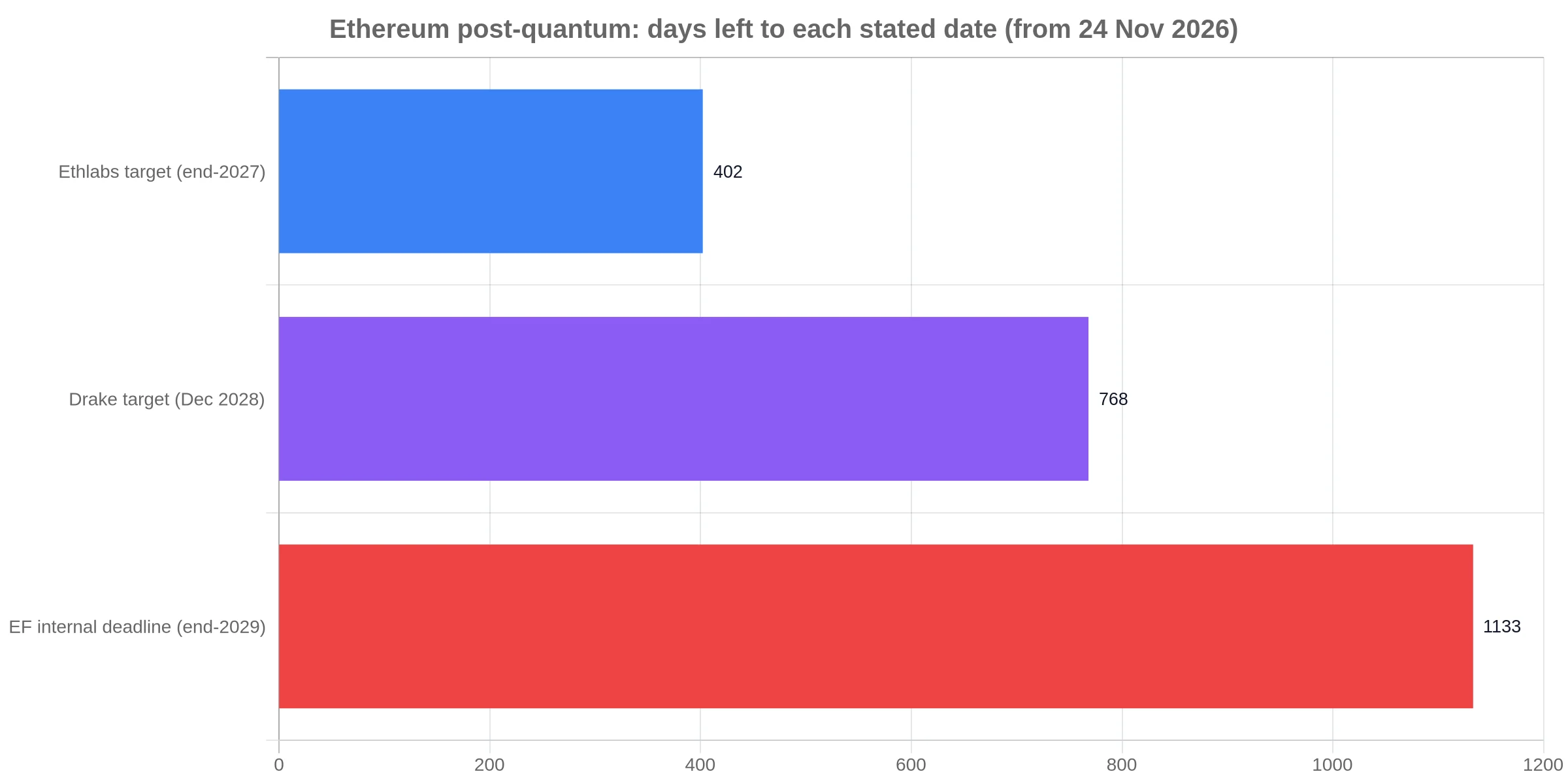
Counted from 24 November 2026, the three dates sit 402, 768 and 1,133 days away. The gap between Ethlabs and the Foundation’s internal deadline is up to 24 months, which is not a rounding difference in a migration that touches every wallet, every staking setup and every rollup.
Hegotá does the first half, a second fork does the rest
Ethlabs splits delivery into two stages rather than one upgrade. Hegotá becomes “pqai-ready,” meaning the network can keep running safely even at reduced capacity. The second stage, which the paper labels I*, restores full capacity: post-quantum data availability replaces the fallback, and signature aggregation lets post-quantum transactions run at normal throughput.
The execution layer and the consensus layer are not on the same clock, and the paper says so. Frames with a post-quantum signature scheme (SPHINCS) and the post-quantum account EIPs can ship from the execution layer without waiting for consensus work. The consensus side is harder: “pq decoupled consensus or pq Gasper is the biggest open question,” the paper states, because making Gasper post-quantum may be easier in the short term while decoupled consensus is the intended end state.
The interim safety net is calldata. While blobs are not post-quantum, rollups can fall back to calldata, which costs more to include but keeps operating. That is a bridge, not a solution, and it is the detail rollup teams need to price before they can plan their own upgrades.
What has already been traded away
Priorities are visible in what gets deferred. The Foundation is blunt about the cost: “Every layer of the protocol and ecosystem will need to adapt to the reality that hardening the protocol is now our highest priority. Features people have spent years on will have to wait.” The post names BLS tooling as work that must be reworked and warns that contracts assuming pre-quantum cryptography will need updates.
Ethlabs goes further on its own proposal. “We will withdraw quick slots from Hegotá and commit to dedicating our resources to pqai27,” it says, while insisting the decision was not casual and that quicker slots return to the agenda for 2028. For validators, the practical risk sits in the same paragraph of the Foundation post: much larger signatures mean hardware requirements have to be watched so people can still run nodes at home.
The AI argument the Foundation is leaning on
Both documents frame quantum risk as slow and AI risk as fast. The Foundation says it has tracked quantum threats for years but that “recently AI emerged as a more urgent risk,” citing models that find bugs in production software faster than people can review them. Ethlabs cites OpenAI finding roughly 1,000 vulnerabilities in the Linux kernel, the US government moving its quantum-readiness goal from 2035 to 2030, and Google targeting post-quantum by 2029.
The Foundation’s post goes as far as citing an AI-assisted proof of the Riemann Hypothesis, a 167-year-old open problem, and then hedges correctly: that “does not immediately imply that AI can or will break the hardness assumptions that our cryptography relies on.” The hedge matters. What the post actually argues is risk management, that relying on the fewest assumptions is cheaper than waiting to find out.
The comparison the Foundation chooses is the one that will be quoted most. “This upgrade is harder than the Merge, and we have less time,” it says. Useful context: The Merge went live on 15 September 2022, 1,531 days ago. The December 2028 target leaves 768 days, or about half the interval between the Merge and today, to repeat a change the Foundation itself describes as more difficult.
Where the bill lands
Account migration is the part users will feel. Wallets, multisigs and staking pools all need changes, and each has its own release cycle. The Foundation pitches the migration as a chance to add rotating keys, recovery keys separated from execution keys and scoped account access, all features that harden accounts against automated attack. That is an argument for doing the work once, not evidence that the work is small.
Staking providers face a separate queue: validators have to move to post-quantum keys, and the paper asks client teams to test what breaks across institutional and home-staking setups. Rollups face the calldata economics described above. Home node operators face bandwidth and storage, because hash-based signatures are substantially larger than the curve signatures they replace, a point both documents make without quantifying.
Market context, for readers who track the token rather than the protocol: ETH traded at $1,707.15 at 05:46 UTC on 24 November, down 65.5% from its $4,946.05 record and 28.1% over 30 days, according to CoinGecko . On today’s supply, that record price implies a market value near $604.6 billion against $208.7 billion now. Neither document mentions price, and nothing in them ties the schedule to the market.
What would settle the calendar
Three items carry real information, and all three are dated or nearly dated. The January timeline review is the first: it can move the internal 2029 deadline in either direction. The remaining All Core Devs calls this year are the second, because the Foundation says they will decide which features to strip out of the fork to free engineering capacity. The first post-quantum consensus-layer devnet is the third, since a devnet that iterates is different from a specification that exists on paper.
Glamsterdam is the unresolved dependency. Its gas repricing is still under audit , with eight broken invariants handed to external reviewers in November. Ethlabs says the fork “ships as planned, and the scaling it enables continues afterwards,” but neither document gives it a mainnet date, and both describe features being removed from it. Until that fork lands, every post-quantum date is a target stacked on an unscheduled predecessor.
There is one more asymmetry worth stating plainly. The Foundation asks client developers, wallet teams, stakers, rollup teams and cryptographers to staff the work, and says one organisation cannot carry the network alone. Deadlines that depend on volunteers outside the Foundation are commitments about coordination, not orders. The 2027 date belongs to a lab with its own engineering resources. The 2028 and 2029 dates belong to an institution that has to persuade everyone else to move at the same speed.
Frequently Asked Questions
There are three published dates. Ethlabs targets 2027 in its pqai27 paper. Justin Drake put December 2028 forward as a target at Devcon. The Ethereum Foundation’s internal deadline remains 2029, with a timeline review planned for January 2027.
It is the first post in an Ethereum Foundation blog series about preparing the protocol for a post-quantum, post-AI environment, published on 23 November 2026 and written by Kev Wedderburn. It sets priorities and argues for hash-based signatures. It is a direction document, not an EIP or an implementation specification.
Yes. Ethlabs describes Hegotá as making Ethereum pqai-ready, with Frames, a post-quantum signature scheme and post-quantum account EIPs, plus post-quantum consensus work on the consensus layer. A later fork, which the paper calls I*, adds post-quantum data availability and signature aggregation to restore full capacity.
Wallets need a migration route for moving an account to hash-based signatures. Staking pools and solo validators need post-quantum keys and tooling that works across institutional and home setups. Multisigs and contracts that assume pre-quantum cryptography need updates, and BLS-based tooling has to be reworked.
Ethlabs withdrew its Quick Slots proposal from Hegotá to free engineering time and says quicker slots return to the agenda in 2028. The Foundation says features teams spent years on will have to wait while protocol hardening becomes the top priority.
Sources: Ethereum Foundation PQAI #0 (23 November 2026), Ethlabs pqai27 (11 November 2026), ethereum.org fork documentation and CoinGecko price data at 05:46 UTC on 24 November 2026. Dates in days are calendar arithmetic from 24 November 2026 to 31 December of each stated year.
The post Ethereum’s Foundation Backs Hash Signatures. The Deadline Is 2027, 2028 or 2029 appeared first on BlockchainReporter .