


HeartSciences shareholders approved the all-stock merger with Fortitude Mining Holdings at a special meeting on November 19, with roughly 86% of the votes cast in favor, according to the release Fortitude published on November 20 . The combined company is expected to be renamed Fortitude Mining Group, Inc. and to trade on Nasdaq under the ticker TUDE, once Nasdaq approves the listing.
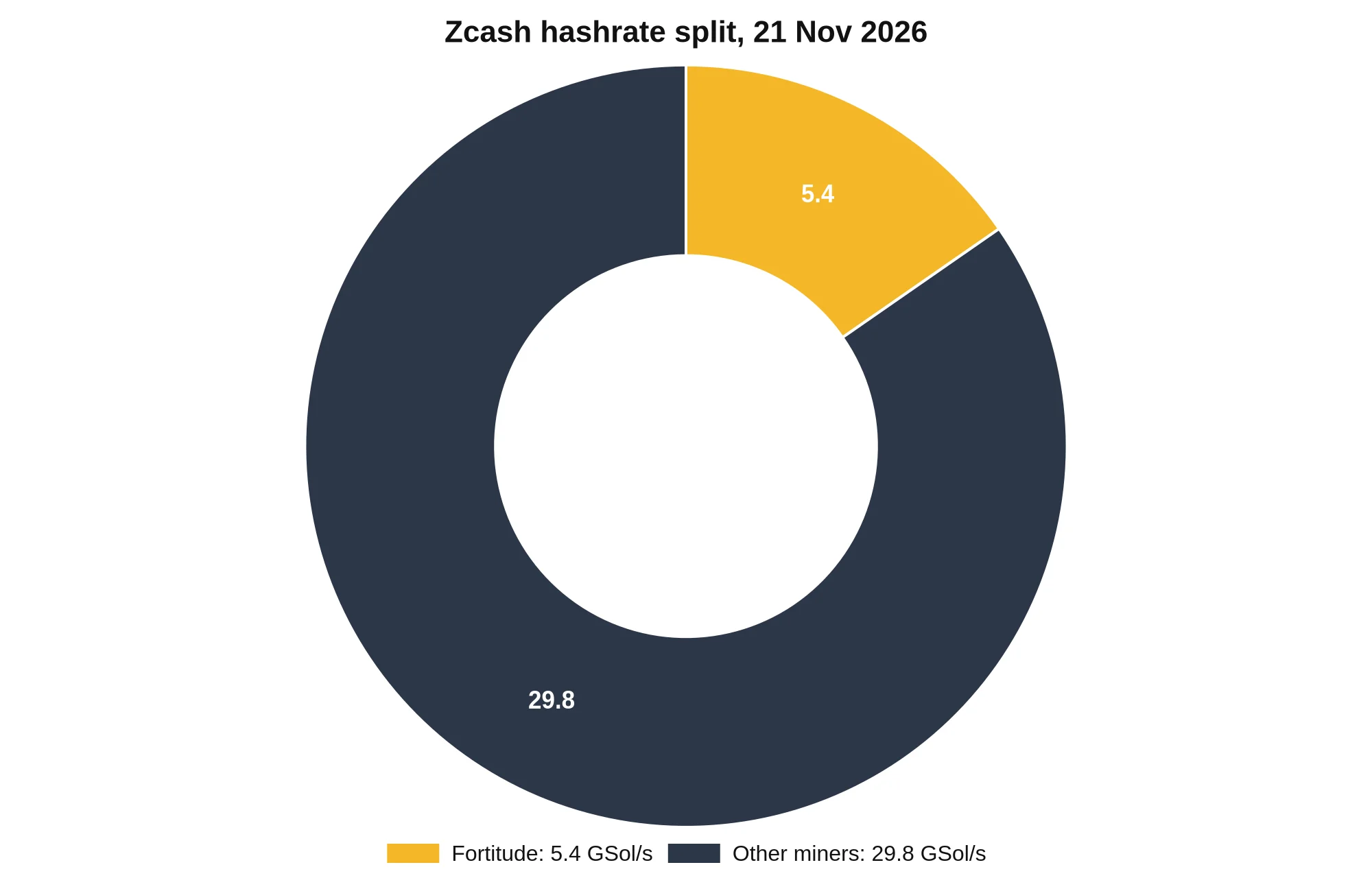
The vote closes the shareholder half of a transaction announced on June 23, 2026 . It does not close the part that decides what the listed company is worth. Fortitude operates more than 60 MW of controlled power across seven U.S. sites in New York, South Dakota, Nebraska and Texas, and reports a Zcash hash rate “currently exceeding 5.4 GSol/s.” The Zcash network was running 35.2 GSol/s on November 21, per Blockchair’s chain statistics , which puts the platform at about 15.3% of the network’s mining capacity.
ZEC traded at $791.07 at 14:47 UTC on November 21, down 2.02% over 24 hours, on a market capitalization of $13.50 billion and 0.63% of total crypto market value. HeartSciences closed at $1.81 on November 20, down 10.8%, inside a 52-week range of $1.63 to $5.25.
What 86% of the Vote Actually Clears
The structure is a reverse merger by share exchange. HeartSciences, an AI-electrocardiography company listed on Nasdaq, becomes the public vehicle for DCG’s Zcash mining subsidiary. After closing, the company takes Fortitude’s name, Fortitude’s chief executive Jaime Leverton runs it, and HeartSciences chief executive Andrew Simpson is expected to keep leading the healthcare business as a unit rather than as the main story.
BlockchainReporter covered the earlier stage of this plan when Fortitude cut its Zcash mining cost 43% and set out the Nasdaq route in July. What changed this week is mechanical: the shareholder condition is satisfied, and the remaining checklist is regulatory and administrative.
The release is specific about one number and silent about the one that matters most to a buyer. It states that approximately 86% of votes cast were in favor but does not publish the total shares voted, the quorum, or the percentage of outstanding shares behind that 86%. The full tally is to appear in a Form 8-K. Until that filing lands, the 86% describes the mood of the meeting, not the strength of the mandate.
5.4 GSol/s Against a 35 GSol/s Network
Zcash issued about 1,571 ZEC in block rewards over the last 24 hours, based on Blockchair’s chain data: 3,428 blocks and 10,951 transactions. A miner holding 15.3% of network hashrate would expect to earn 15.3% of that issuance, or roughly 241 ZEC a day. At the current price that is about $190,700 of gross revenue a day, or $69.6 million annualized, before power, staff and hosting costs.
Those are expected values, not realised ones. Mining is a lottery with a fixed number of tickets per round, so a 15-day sample of an operator at 15% of the network can swing by more than a third either way. The expected-value arithmetic is still the only way to compare a miner’s capacity with its revenue.
Then there is the company’s own production claim, which does not reconcile with itself. The June release says Fortitude had scaled annualized production to 157,000 ZEC, and in the same sentence describes that as “approximately 366 ZEC per day.” At 366 a day the annual figure is 133,590 ZEC, not 157,000, a gap of 23,410 coins, or about 15%. The two numbers may come from different periods of hashrate; the release does not say which is current.
The distinction is not pedantic. A 366 ZEC daily run rate implies 23.3% of today’s network issuance, which would require either a much larger share of the network than 5.4 GSol/s delivers at current difficulty, or a network that was mining at roughly 23 GSol/s when the figure was set. Fortitude’s expected output against today’s chain is about 241 ZEC a day. Which of those numbers an investor should underwrite is the first question the 8-K and the next quarterly update should answer.
The $2 Million Contribution, Counted in Coins
One term of the merger agreement has a price attached. Fortitude must contribute $2 million in cash or ZEC to HeartSciences at closing in exchange for Class A shares, and the release says the contribution “may be contributed by DCG, its parent company.” At $791.07, $2 million buys 2,528 ZEC. Zcash produced about 1,571 coins in the last 24 hours, so the contribution is equal to roughly 1.6 days of the entire network’s issuance.
Fortitude also states that the combined company “expects that the combined company will liquidate the contributed ZEC for proceeds to fund certain closing costs or other expenses in connection with the business combination.” The listing, in other words, is part-funded by selling the asset the listing is meant to give investors exposure to. Two million dollars is small against a $13.5 billion network, and the release frames it as a closing mechanic rather than a capital raise. It is still the clearest statement in the document about how the company treats ZEC it receives.
A Producer That Sells Every Coin It Mines
The disclosure that matters most for anyone treating TUDE as a Zcash proxy sits in the risk language. “In the ordinary course of business, Fortitude currently sells or otherwise monetizes all the digital assets that it mines, including ZEC,” the release states, adding that Fortitude, its affiliates and DCG “from time to time sell, pledge or otherwise monetize their digital asset holdings, including ZEC.”
That is a different instrument from a treasury vehicle. Cypherpunk, which mined 8,967 ZEC in 44 days and holds about 2% of supply , gives shareholders a balance sheet that grows in coins. Fortitude gives them a conversion machine: power and machines go in, ZEC comes out, and the ZEC is sold. The equity is a claim on mining margin, the spread between the cost of producing a coin and its market price, not a claim on a growing pile of coins.
That distinction sets the sensitivity. At 241 ZEC a day, every $100 move in the ZEC price changes daily revenue by about $24,100, or $8.8 million a year. A doubling of the price doubles revenue; a halving does the reverse, while the power bill stays where the contract put it. Sixty megawatts at 5.4 GSol/s works out to about 11.1 kW per MSol/s of capacity, a measure of how much electricity the platform burns per unit of hashrate it controls, and the cost of that electricity is the fixed leg of the trade.
For a protocol reader, this is the familiar proof-of-work structure: security bought with electricity, paid for in newly issued coins, with the operator as a levered intermediary. The lever only pays while the coin price covers the power cost. Fortitude’s pitch is that its vertical integration, from long-term power contracts to in-house operations and maintenance, produces Zcash “at a significant discount to spot pricing.” The release does not quantify the discount, which is why the 43% cost reduction disclosed in July is the only hard efficiency number on record.
Two Board Seats and the DCG Question
The combined company will add Elizabeth B. Higgins and Simcha Wurtzel as independent directors at closing. Higgins is executive vice president and chief financial officer of Oglethorpe Power Corporation, a utility finance role that maps onto a business whose largest cost is electricity. Wurtzel is chief financial officer of RECAP Investment Management Solutions, and the release notes that he previously served as principal financial officer of Grayscale Investments and held finance roles at DCG.
Leverton framed the appointments around governance: “Building a premier public platform for Zcash requires world class governance and deep sector expertise,” he said. “Elizabeth and Simcha bring exactly that.” Both are described as independent, and the relevance of the DCG history is a matter for the proxy and the 8-K rather than for inference: Fortitude is wholly owned by DCG, so in an all-stock merger the shares issued for Fortitude go to DCG, and the release does not state what stake DCG will hold after closing. That percentage, not the board bios, will decide how much of the public float is actually public.
The Approval That Is Still Missing
Nasdaq’s listing approval is the remaining gate named in the release, and no date is attached to it. “The transaction remains subject to the satisfaction of the remaining closing conditions, including Nasdaq approval of the combined company’s listing,” the document states. There is no closing date, no expected first trading day and no guidance on whether the healthcare unit will be reported as a separate segment. Those omissions are normal at this stage and also mean the timetable is unhedged.
What would change the read is measurable. A difficulty adjustment upward at constant hashrate cuts the expected 241 ZEC a day; ZEC holding above $790 keeps the annualized revenue estimate near $70 million; a Nasdaq approval converts the ticker from intention to instrument. None of those is a prediction. They are the three variables the release leaves open, and each one is published on a schedule: every 2,016 blocks for difficulty, every block for the price, and on Nasdaq’s own timeline for the listing.
For now the vote is real and the arithmetic is checkable. Fortitude controls about 15% of Zcash’s mining capacity, produces a coin it sells, and is asking public investors to value a margin business at the moment the underlying asset is 2% lower than it was a day ago. That is a narrower proposition than “Zcash exposure,” and a more specific one.
Data: Blockchair , Coinbase , Yahoo Finance . Prices at 14:47 UTC on November 21, 2026.
Frequently Asked Questions
Fortitude Mining Holdings is a Zcash mining company wholly owned by Digital Currency Group. It is merging with Nasdaq-listed HeartSciences in an all-stock deal. After closing, the combined company is expected to be renamed Fortitude Mining Group, Inc. and to trade on Nasdaq under the ticker TUDE, subject to Nasdaq approving the listing.
Yes. At a special meeting on November 19, approximately 86% of the votes cast were in favor of the business combination, according to Fortitude’s November 20 release. The detailed vote count is to be reported in a Form 8-K filed with the SEC.
About 15.3%. Fortitude reports an operating hash rate above 5.4 GSol/s, against a Zcash network hash rate of 35.2 GSol/s on November 21, 2026, per Blockchair. At that share the platform would expect roughly 241 of the 1,571 ZEC issued each day.
No date has been given. The release says the transaction remains subject to remaining closing conditions, including Nasdaq approval of the combined company’s listing, and it does not state an expected closing date or first trading day.
By its own description, no. The release states that Fortitude currently sells or otherwise monetizes all the digital assets it mines, including ZEC, and that it and DCG may sell or pledge holdings from time to time. It also expects the combined company to liquidate the $2 million ZEC contribution to fund closing costs.
This article is news reporting, not investment advice. Hashrate, issuance and price figures are dated to 14:47 UTC on November 21, 2026, and expected production is calculated from hashrate share rather than realised blocks.
The post Fortitude Clears the Nasdaq Vote. The Zcash Numbers Behind TUDE Are the Real Test appeared first on BlockchainReporter .