



The calm sophistication of the Bitcoin market's recent price fluctuations is on full display. In the midst of headlines focused on Bitcoin's, Ethereum's, and Dogecoin's small recoveries and XRP's small drop, the real drama is unfolding in the order books.
Amid a market engulfed in "Fear," a coordinated, aggressive short-selling effort by well-funded individuals is preparing the ground for a potentially violent, trend-defining action.
Things are far from stable right now; in fact, they're more like a tightly wound spring, and everything points to a release very soon.
The "Fear" Signal and Macro Headwinds
The market's general mood is very clear. The Crypto Fear & Greed Index stands at 30, firmly within the "Fear" region, according to data from August 17. This is a significant drop from the 35 recorded several days ago, indicating that the market is still dealing with the difficult macroeconomic climate.
The rising geopolitical tensions between the United States and Iran are the primary cause of this risk-averse environment.
According to Equiti's experts, the 30% spike in crude oil prices in July is a direct result of the escalating conflict in the Middle East. This puts pressure on cryptocurrency valuations because people are more worried about inflation and expect the Federal Reserve to take a stronger stance.
The market adjusted risk premiums along an "Energy-Inflation-Dollar-Risk" axis after the military actions of U.S. Central Command in June validated this dynamic.
The market has taken in the first shock of these developments, but there's still a long way to go before we can relax our guard and enjoy any gains. This is the big-picture setting where the subsequent little fight is taking place.
Markets are sceptical of taking the current market stabilization around $62,900 as an indication of strength; rather, it seems to be a brief respite prior to the next noteworthy shift.
A Coordinated Whale Attack: Anatomy of a Short Position
Against the backdrop of this environment of macroeconomic uncertainty, an exceptionally distinct signal has emerged on-chain.
Two well-known Bitcoin holders, identified by addresses beginning with 0x8c96 and 0x431f, have recently engaged in coordinated market manipulation, which is typical of institutional techniques.
As a maneuver, this is not an ad hoc assemblage of shorts. Based on what we know from BlockBeats, there is a copy-trading relationship that is almost algorithmically coordinated. With their first entries coming only 1.3 seconds apart, the two entities have executed 181 virtually synchronized deals.
Their overall short exposure reached an astounding 2,675 BTC, worth around $169 million, when they added 585.3 BTC to their short holdings on August 17 at an average price of about $62,935.
A lot of thought went into developing the plan. They are both using 22x isolated leverage, which is a very risky technique that might mean they are really convinced of something, or they are trying to push the price down.
A major "pain point" for these vendors is the fact that their liquidation prices are almost identical, sitting just above $65,100. Also, 37.5% of their total position is attributable to the use of consolidated reduce-only stop-market orders, totaling $63,971.
The key players are not only betting against the market; they are coordinating their exposure management plan to create a strong sell wall right above the current price, limiting any quick increase.
This is the sign of a well-developed strategy.
Bitcoin ETFs Bleed While Ethereum Holds Flat
Institutional hesitancy is evident in last week's ETF flows. After their best week since April, Bitcoin ETFs had a net outflow of over $390 million, with Monday's loss of about $145 million being the main driver.
Ethereum exchange-traded funds (ETFs) saw negligible activity, with a net outflow of barely $2.26 million, as investments into Grayscale's mini trust more than offset those in BlackRock's ETHA.
The market is presently suspended, as indicated by this divergence. Market movements are being muted by the fact that summer liquidity is still low, even if US labor data is weakening and the Consumer Price Index is cold.
Institutional focus remains on Bitcoin rather than diverting to other cryptocurrencies, indicating a low risk appetite.
Important considerations this week include the July FOMC minutes and developments in the Strait of Hormuz geopolitical situation.
Inflows into exchange-traded funds are likely to be unpredictable until the uncertainty surrounding the rate path is resolved.
The Technical Battlefield: A Classic Squeeze Setup
This aggressive shorting is happening at a critical technical juncture. Typically, a structure such as the one Bitcoin is currently exhibiting - a tightening range - signals an impending and substantial price change.
According to TradingView, the current price action has the market in a delicate zone between important support and resistance levels, as Bitcoin continues to hover at the $63,000 mark.
Around $64,095 is where the previous month's "Point of Control" was, marking the sweet spot for trading activity and a critical level of optimism.
If the market consistently closes above $64,000 daily, it would signal a positive change in dynamics and might potentially lead to a short squeeze.
This area is considered major resistance.
Important support is seen around $62,400, and the negative scenario is dependent on a decline below the last trading range's bottom limit.
If there is a sharp drop below this mark, it can lead to a drop approaching the $60,000 psychological support level.
The key technical equation is that price is stabilizing, and a major breakout is imminent.
The Endgame: Navigating the Squeeze
The coming week's risk-reward dynamics are drastically altered by the presence of these large, structured short positions.
A major turning point has been reached with the whales' liquidation prices above $65,100.
With their $169 million short bet turned into buying pressure, these 22x leveraged traders will be forced to unwind their positions if Bitcoin manages to break through the $64,000-$64,400 barrier zone.
With some experts pointing out the structural similarities to a bear-market conclusion, the possibility for a big "short-squeeze" is high.
On the other hand, major participants have structured their trading approach with a well-defined protective perimeter.
To mitigate losses caused by negative price fluctuations, there are stop-loss orders placed around $63,971. Nevertheless, a temporary obstacle to price increases can be created by the large volume of these orders.
Everyone in the trading community, from individual investors to large financial institutions, can see that one entity is driving price changes.
The best course of action is to identify the key levels and wait for a permanent break above $64,400 or a break below $62,400.
The real opportunity lies in grabbing the next spike once the consolidation period ends, not in engaging in this range. The market must now decide whether to counter the large players' strategy or not; they have already moved.
What Other Technical Readings Show?
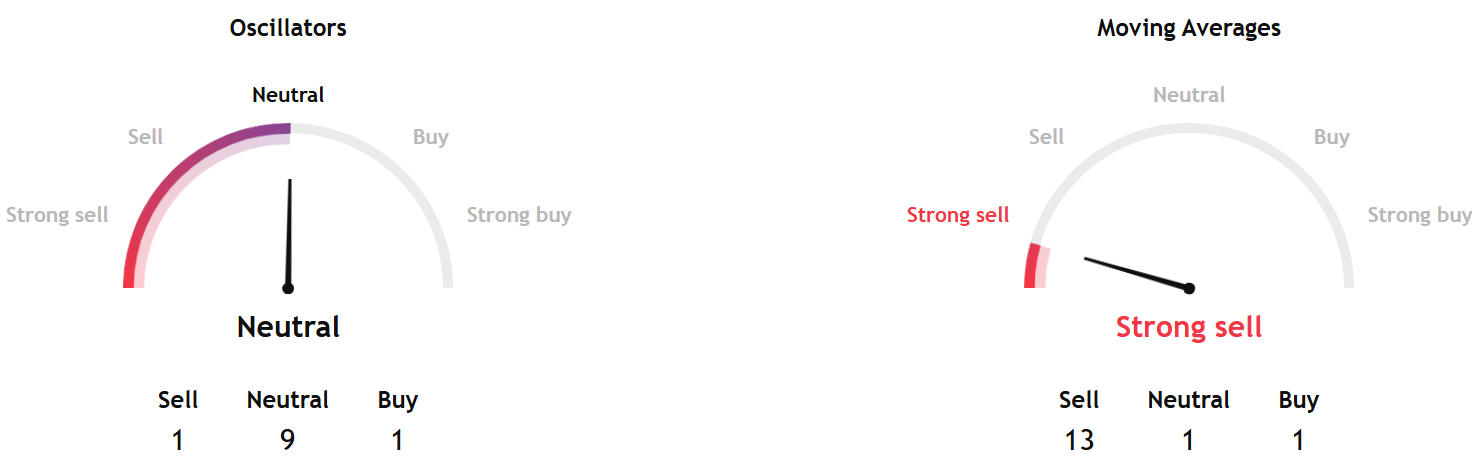
TradingView's technical analysis overview for the week ahead, based on key data from moving averages, oscillators, and pivot points, points to a sell signal.
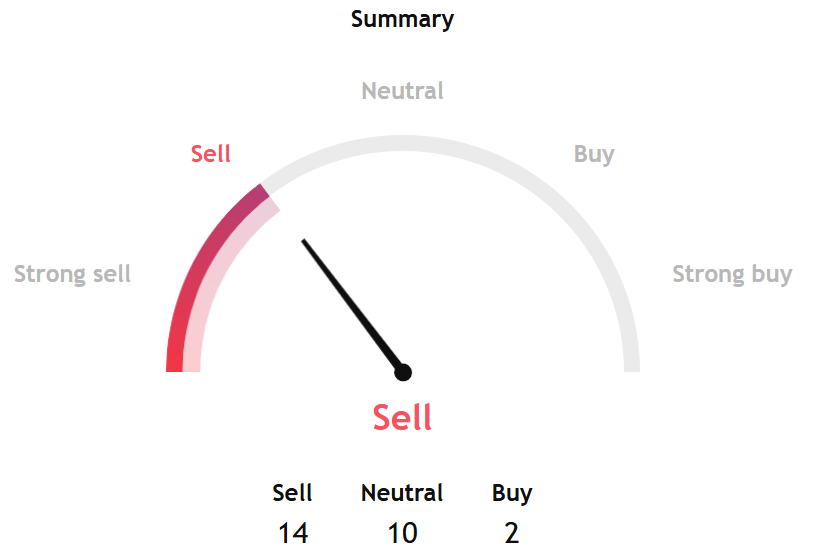
But the oscillators sub-indicators point to a neutral stance, even as moving averages readings show a strong sell signal.
Separately, InvestTech's Algorithmic Overall Analysis gave a weak negative score, even as the research's one-to-six-week recommendation was for a hold: "Bitcoin is within an approximate horizontal trend channel in the short term, which indicates further development in the same direction. A head and shoulders formation is under development. A decisive break of the support at $63,157, ideally with an increase in volume, signals a further fall. The token is testing support at $63,000. This could give a positive reaction, but a downward breakthrough of $63,000 means a negative signal."
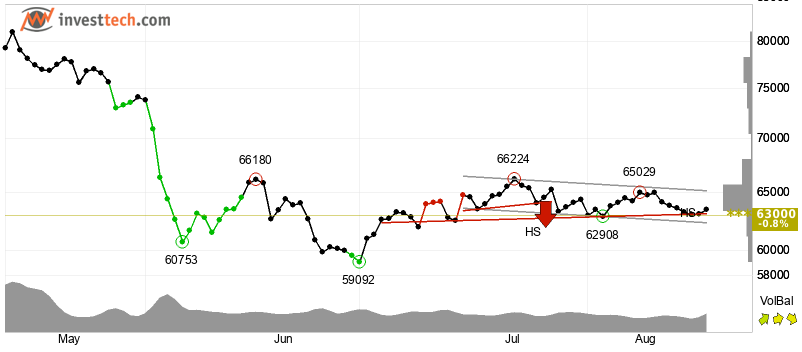
InvestTech added, "The RSI curve shows a rising trend, which is an early signal of a possible trend reversal upwards for the price as well. The currency is overall assessed as technically neutral for the short term."