

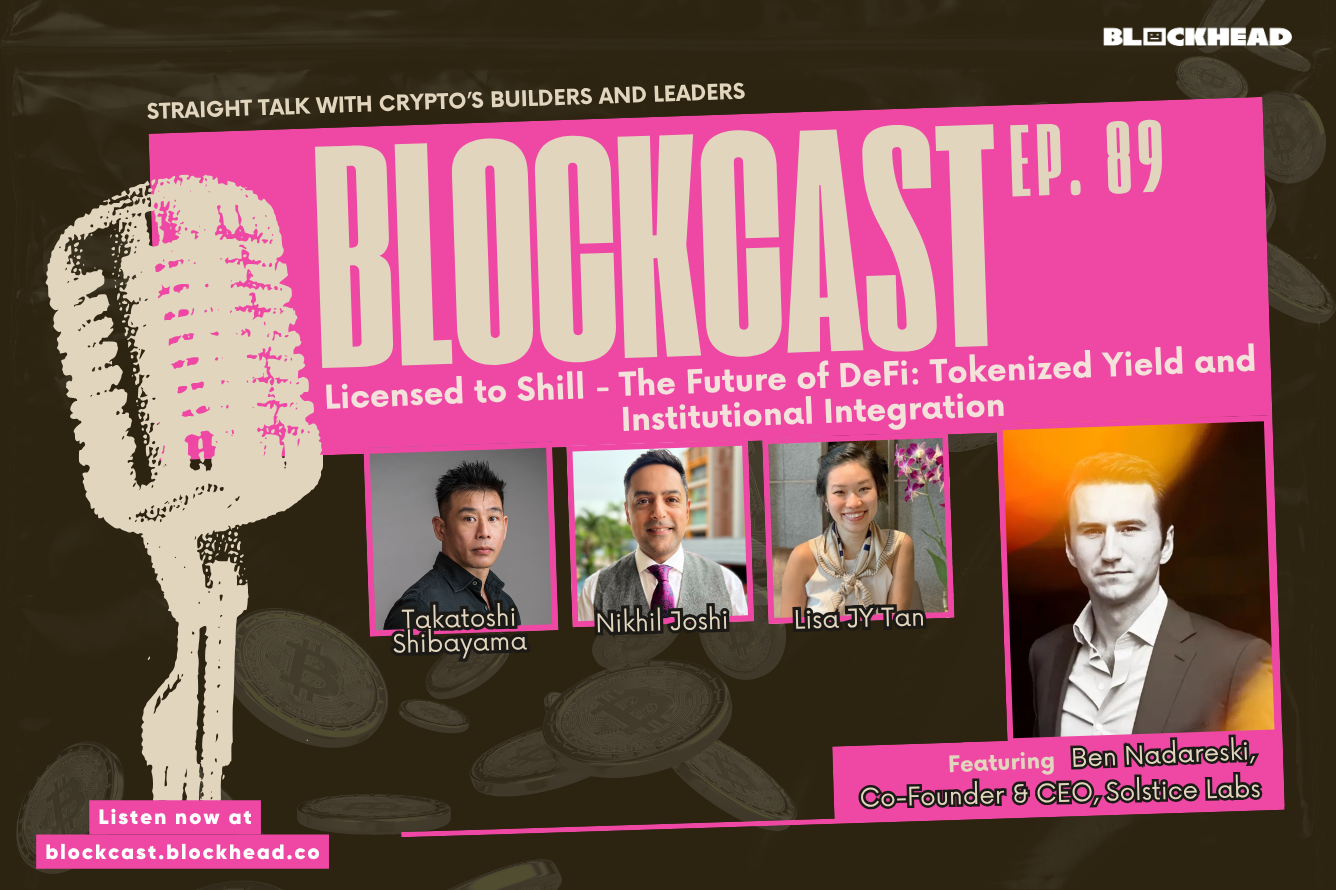
The first phase of decentralised finance produced stablecoins. The second brought real-world assets on chain. Ben Nadareski, CEO of Solstice , believes the third phase – tokenized yield – is already underway, and that his protocol is building the infrastructure to prove it.
In the latest episode of Blockhead's Licensed to Shill podcast, Nadareski laid out Solstice's positioning as the yield layer for Solana: a protocol that issues a synthetic stablecoin, USX, as a gateway to a suite of institutional-grade yield strategies, with EUSX as its flagship delta-neutral product.
The model is designed to serve institutional and retail investors through the same onchain infrastructure, but via different entry points. Large institutions mint directly through an offshore regulated fund with standard KYC and AML procedures.
Retail participants can access the same products permissionlessly via any decentralised exchange. "We have a deep liquidity pool with Solstice now over 500 million of liquidity," Nadareski said. "Those are coming primarily from the institutional side."
EUSX's yield is generated from three strategies: basis and arbitrage on the delta-neutral funding rate between spot and perpetual futures, hedge staking of the underlying spot asset, and tokenized treasuries. Nadareski said the strategy has four and a half years of trading history and over $400 million in capital deployed through Deus X Capital, a trading group Solstice acquired to bring the strategy in-house. Trading occurs on centralised exchanges rather than DeFi protocols – a deliberate choice to avoid auto-deliquidation exposure.
The recent wave of DeFi exploits came up during the conversation, with Nadareski citing the Drift hack and Kelp DAO among the incidents that had secondary effects across the industry. His view was pointed: the problem is not that DeFi is structurally insecure, but that many protocols never approached it with the rigour of financial management. "In the early days of crypto, a lot of people forgot that we were actually financial managers on top of tech innovators," he said.
Solstice publishes third-party security audits from Halborne and SEP2, maintains a three-of-five multi-sig with time lock implementation, and works with Accountable and Chainlink for proof-of-reserves attestations. Nadareski framed this transparency as exceeding what traditional banks offer – noting that banks do not publish independent audits of their custody arrangements or yield-generation practices. "Expect more out of DeFi, because DeFi can deliver," he said.
For prospective DeFi investors, he offered three due diligence benchmarks: where custody of assets actually sits and how it is independently attested; whether the protocol has current third-party security audits; and where the yield is coming from and what mechanism sustains it.
The last point was echoed by co-host Lisa JY Tan, CEO of Economics Design, who flagged that many projects still launch tokens without any underlying business model. "How are they making money? Where is yield coming from?" she said. "If it's just all based on hype, that is not part of doing good due diligence."
Solstice's governance and utility token, SLX, launched on May 25. Nadareski was emphatic that the business was profitable before the token generation event. "The token itself is not our core financing model," he said. "We're a yield provider first." SLX is designed for governance voting, incentivising ecosystem behaviours such as instant redemptions, and staking – rather than as a speculative price vehicle.
On the broader Solana ecosystem, Nadareski was direct about why Solstice chose the network. He cited the foundation's active co-investment through Solana Ventures, developer incentives, and on-chain activity metrics as evidence that the Solana Foundation is doing something other L1 foundations have not matched. He was careful to add he is not a Solana maximalist, but pointed to Cardano as an example of a foundation that has been less visible in driving ecosystem growth. "There's a reason why Solana has seen the most amount of developer activity," he said. "This has been the most explosive L1 ecosystem to be building on."
If you enjoyed this episode, please like and subscribe to Blockcast on your favorite podcast platforms like Spotify and Apple .
Blockcast is hosted by Head of APAC at Ledger, Takatoshi Shibayama . Previous episodes of Blockcast can be found here , with guests like Daren Guo (Reap), Yat Siu (Animoca Brands), Kean Gilbert (Lido), Joey Isaacson (Nook), Kapil Dhiman (Quranium) Eric van Miltenburg (Ripple), Davide Menegaldo (Neon EVM), Anastasia Plotnikova (Fideum), Jeremy Tan (Singapore parliament candidate), Hassan Ahmed (Coinbase) and more on our recent shows.