hayden.eth ?
@haydenzadams
RT
@Kaffchad: I used to see $UNI as one of those OG DeFi tokens with great product metrics but almost no reason for the token itself to exist.
@Uniswap could dominate spot volume, generate hundreds of millions in fees and still leave UNI doing nothing. That thesis is starting to change imo. The fee switch finally went live on v2 and selected v3 pools across 11 chains. We also got aggregator hooks that can eventually make v4 burn UNI even when trades route through external liquidity. So trades now create revenue to buy back and burn $UNI. First time ever usage and supply are actually mechanically linked. – 6M-8M $UNI burned so far, H1 averaging ~1M/month – one-time 100M $UNI burn already deleted a chunk of supply Token is finally clawing back against dilution.Still not fully offsetting the 20M annual $UNI going to Labs, but the math ain't what it used to be. Meanwhile Uniswap still the undisputed final boss of De
@Kaffchad: I used to see $UNI as one of those OG DeFi tokens with great product metrics but almost no reason for the token itself to exist.
@Uniswap could dominate spot volume, generate hundreds of millions in fees and still leave UNI doing nothing. That thesis is starting to change imo. The fee switch finally went live on v2 and selected v3 pools across 11 chains. We also got aggregator hooks that can eventually make v4 burn UNI even when trades route through external liquidity. So trades now create revenue to buy back and burn $UNI. First time ever usage and supply are actually mechanically linked. – 6M-8M $UNI burned so far, H1 averaging ~1M/month – one-time 100M $UNI burn already deleted a chunk of supply Token is finally clawing back against dilution.Still not fully offsetting the 20M annual $UNI going to Labs, but the math ain't what it used to be. Meanwhile Uniswap still the undisputed final boss of De
@Kaffchad
I used to see $UNI as one of those OG DeFi tokens with great product metrics but almost no reason for the token itself to exist.
@Uniswap could dominate spot volume, generate hundreds of millions in fees and still leave UNI doing nothing.
That thesis is starting to change imo.
The fee switch finally went live on v2 and selected v3 pools across 11 chains.
We also got aggregator hooks that can eventually make v4 burn UNI even when trades route through external liquidity.
So trades now create revenue to buy back and burn $UNI. First time ever usage and supply are actually mechanically linked.
– 6M-8M $UNI burned so far, H1 averaging ~1M/month
– one-time 100M $UNI burn already deleted a chunk of supply
Token is finally clawing back against dilution.Still not fully offsetting the 20M annual $UNI going to Labs, but the math ain't what it used to be.
Meanwhile Uniswap still the undisputed final boss of DeFi spot:
– $3.1B TVL
– $45.3B monthly DEX volume
– $860M annualized fees
– $47.7M annualized revenue
Then RH happened and showed everyone the scale. UniswapX as native liquidity layer did $563.9M volume in one day (july 8).
At peak, RH was ~$4.38M of Uniswap's $5.16M daily fees One new distribution channel temporarily generated almost the whole protocol's fee base.
Uniswap sitting underneath every major EVM chain like the silent liquidity landlord
If attention keeps rotating to chains like Base/Robinhood, a 3-6% yearly net supply reduction is actually on the table.
v4 hooks let protocols build custom pools, dynamic fees, oracle logic, lending integrations and new execution models without rebuilding a full DEX.
The moat is becoming a settlement layer other protocols customize around.
Then institutional plumbing is quietly showing up on top.
– @sparkfinance recently migrated $150M of stablecoin liquidity into Uniswap v4
– @BlackRock's BUIDL became accessible through UniswapX.
– @Fidelity's FIDD liquidity moved into Uniswap.
– @OndoFinance connected more than 430 tokenized stocks and ETFs to Uniswap liquidity.
Together they change what Uniswap is being valued as.
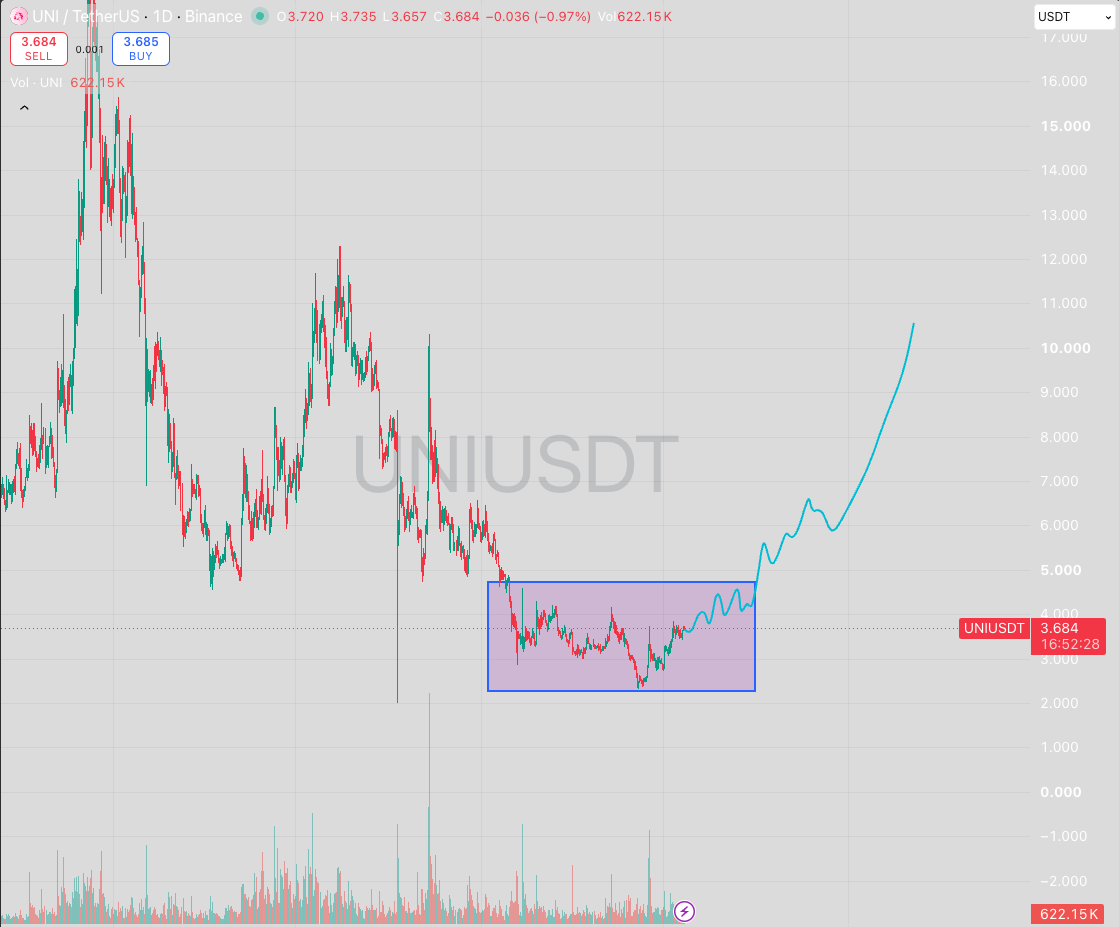
At $3.55, $UNI is trading at just 2.58x trailing gross fees, while $HYPE trades at ~19.7x P/F.
– reprice to 5x → $6.88 / $6.15B FDV
– reprice to 7x → $9.63 / $8.61B FDV
– reprice to 10x → $13.76 / $12.29B FDV
The old discount made sense when UNI captured nothing. But now that fee capture, sequencer revenue, MEV auctions and usage-linked burns are live.
That old math is breaking in real time.
Watch the captured share climb off a small base while total fees keep expanding.
ngmi if you're still sleeping on this.