

By February 2028, the machines at CleanSpark’s Sandersville site in central Georgia are scheduled to stop. The power that has been pushing hashpower through them since the site came online will be redirected into buildings leased to a single tenant for twenty years. The company booked the consequences of that decision on November 24, in a fiscal 2026 annual report that carries one number everyone will quote and several that explain it.
That number is a net loss of $987.1 million, or $3.74 per basic share, against net income of $364.5 million a year earlier. It came with fourth-quarter net income of $9.8 million, revenue of $120.9 million that was 46% lower year over year, and an adjusted EBITDA figure for the quarter of $345.4 million. Read in sequence, those figures look incoherent. Read against the earnings release filed with the SEC as Exhibit 99.1 , they describe a company whose income statement has become a bitcoin price chart with a data center business attached to it.
What CleanSpark Actually Reported
Fiscal 2026 ended September 30 with bitcoin mining revenue of $576.5 million, down 24.8% from $766.3 million. Cost of revenues, the cash line that covers power and site operations, barely moved: $342.3 million against $343.1 million. Payroll rose to $114.8 million from $104.4 million, general and administrative costs to $65.0 million from $52.6 million, and professional fees to $28.4 million from $13.8 million.
Depreciation and amortization reached $428.2 million, up from $348.3 million, a figure that reflects a 2024 decision to shorten miner useful lives to three years rather than the fleet getting larger. Total costs and expenses came to $1.46 billion against $447.4 million in fiscal 2025. Loss from operations was $883.5 million.
Then the balance sheet, which is where the story turns. Cash and equivalents ended the year at $204.8 million. Restricted cash classified as noncurrent reached $2.05 billion, the proceeds from the September note sale sitting in escrow for construction. Long-term debt net of discount and issuance costs went from $644.6 million to $3.99 billion. Total liabilities of $4.46 billion now sit against total assets of $5.25 billion, and stockholders’ equity fell from $2.18 billion to $786.0 million.
| Fiscal year ended September 30 | 2026 | 2025 |
|---|---|---|
| Bitcoin mining revenue, net | $576.5M | $766.3M |
| Loss (gain) on fair value of bitcoin | $281.6M loss | $425.6M gain |
| Loss (gain) on bitcoin collateral | $118.7M loss | $92.2M gain |
| Impairment expense | $177.1M | None |
| Net income (loss) | ($987.1M) | $364.5M |
| Adjusted EBITDA | ($304.2M) | $823.4M |
Where the Loss Comes From: Two Price Marks, Not an Invoice
CleanSpark applies fair value accounting to the bitcoin it holds, under the standard commonly referenced as ASC 350-60. That means the coins are marked to market every reporting period and the change runs through the income statement rather than sitting quietly in equity. In fiscal 2026 the mark went the wrong way.
The company recorded a $281.6 million loss on the fair value of its bitcoin, against a $425.6 million gain the prior year. It recorded a separate $118.7 million loss on bitcoin posted as collateral, against a $92.2 million gain. Together that is $400.4 million of non-cash marks, or 40.6% of the entire annual net loss.
The collateral number has a clean provenance in the Form 10-K filed the same day . The loss “pertains to the change in the underlying collateralized bitcoin’s fair value from approximately $114,100 per bitcoin on September 30, 2025 to approximately $83,600 per bitcoin on September 30, 2026.” A 26.7% decline in the reference price, applied to coins pledged against borrowing, produced nine figures of accounting loss.
Strip both marks out of adjusted EBITDA and the operating picture changes sign. Adjusted EBITDA was a loss of $304.2 million, and because the company’s own reconciliation explicitly does not exclude the bitcoin marks, adding them back produces positive $96.1 million for the year. CleanSpark’s cash operations covered their costs. The loss is what happened to the asset it was holding while it did so.
The Quarter That Looks Profitable Until You Strip the Mark
The fourth quarter makes the same point more sharply. Adjusted EBITDA of $345.4 million reads like a business that turned a corner in the final three months. But the same quarter contained a $305.6 million gain on the fair value of bitcoin and a $40.2 million gain on bitcoin collateral, a combined $345.8 million. Subtract those two items from the reported adjusted EBITDA and what remains is negative $0.4 million.
In other words, essentially all of the quarter’s headline profitability was the bitcoin price moving in CleanSpark’s favor between July and September. The operating business, at the EBITDA line, was flat to slightly negative in a quarter when revenue fell 46%. That is not a criticism of the accounting. It is a description of what the number is measuring.
The quarter also carried $171.7 million of impairment, which is the part of the release that has nothing to do with bitcoin’s price.
Sandersville: The Asset That Got Written Down, and the Lease That Replaced It
In July 2026 CleanSpark signed a 20-year triple-net lease at Sandersville with what it describes as a high investment grade tenant, a contract the company values at $6.6 billion over its term. The tenant is not named in the filing. The power capacity that currently supports mining at the site is being converted to data center use, and mining there is expected to end by February 2028, with full decommissioning during fiscal 2028.
Because the mining asset group at Sandersville will not live out its depreciable life, it had to be tested for impairment. On July 10, 2026, long-lived assets with a carrying amount of $277.1 million were written down to a fair value of $109.0 million, determined through an orderly liquidation assessment. The Sandersville asset group accounted for $154.0 million of the charge, an evaluation of less efficient miners in the wider fleet added $14.1 million, and deposits for equipment no longer expected to be used added $9.0 million, for $177.1 million in total.
The company’s own language in the filing is unsentimental about the mechanism:
“The transition analysis related to decommissioning the Sandersville mining site and the related evaluation of certain less-efficient miners within our mining fleet resulted in the recognition of non-cash impairment charges totaling $168,102.”
Construction is funded. CleanSpark sold $2.276 billion of 7.875% senior secured notes due October 1, 2031, issued at 98.5% of principal, through subsidiary CSDC Finance I. The company says the first planned data hall is on track for November 2027, that it has reached basis-of-design alignment on the full anticipated project, signed a turnkey lump-sum development contract with its EPC management contractor, and pre-paid for long-lead items.
What the filing does not show is a signed tenant anywhere else. The Texas portfolio, 285 MW at Sealy and up to 600 MW at Brazoria, received conditional Batch Zero baseload designation on 585 MW and a studied-load designation for Brazoria Phase 2. But the exclusivity periods at both sites “expired during a period of temporary regulatory uncertainty,” and commercialization talks are proceeding with the Sandersville tenant and others. One contracted lease is not a data center business yet, and the segment disclosure confirms it: the Data Center Infrastructure segment had executed a lease but had not commenced recording leasing revenue as of September 30.
The Interest Bill Arrives in Fiscal 2027
Fiscal 2026 interest expense was $11.9 million, essentially unchanged from $11.3 million, because the big notes were issued on September 25, six days before year end. The full coupon lands in fiscal 2027. At 7.875% on $2.276 billion, the annual cash interest is roughly $179.2 million, which is 31.1% of what the entire company generated in revenue last year.
That is a fixed obligation against a variable revenue stream, and it is the reason the $96.1 million of marks-adjusted operating EBITDA matters. The cushion is thin. The Sandersville lease is designed to cover it, but lease revenue does not begin until a data hall is delivered, and CleanSpark’s first is scheduled for November 2027, inside fiscal 2028, not fiscal 2027.
Total debt of $4.08 billion against $786.0 million of equity is a ratio of 5.2 to 1. Operating cash flow for the year was negative $468.4 million. The company also filed an automatic shelf registration statement on Form S-3ASR the same day as the annual report, which gives it capacity to raise further capital without a separate waiting period.
13,530 Bitcoin, Marked at $83,555 and Now Worth Less
CleanSpark held 13,530 bitcoin including collateral at year end, which the release values at $1.13 billion. That implies a reference price of $83,555 per coin, consistent with the $83,600 figure used for the collateral calculation. At bitcoin’s price of $59,951 at the time of writing, that stack is worth about $811.1 million, a decline of roughly $319.4 million, or 28.2%.
None of that loss appears in the fiscal 2026 statements. It belongs to the current quarter, and it will be recorded the same way the fiscal 2026 marks were, through the income statement, unless the price recovers before December 31. Anyone reading the annual report as a statement about CleanSpark’s current balance sheet is reading a snapshot that is already 55 days old in the most volatile line item on it.
The company also generated $30.6 million of derivative-related proceeds during the year through its Digital Asset Management program, a figure worth watching because it is one of the few places where management’s bitcoin price view converts into actual dollars rather than marks.
Fewer Machines, More Coins per Unit of Hashrate
The mining operation itself got smaller and better. CleanSpark mined 7,253 bitcoin in fiscal 2026, down 8%, despite average hashrate falling 21% to 36.0 EH/s. Fleet efficiency improved to 14.8 joules per terahash at year end from 16.7 a year earlier.
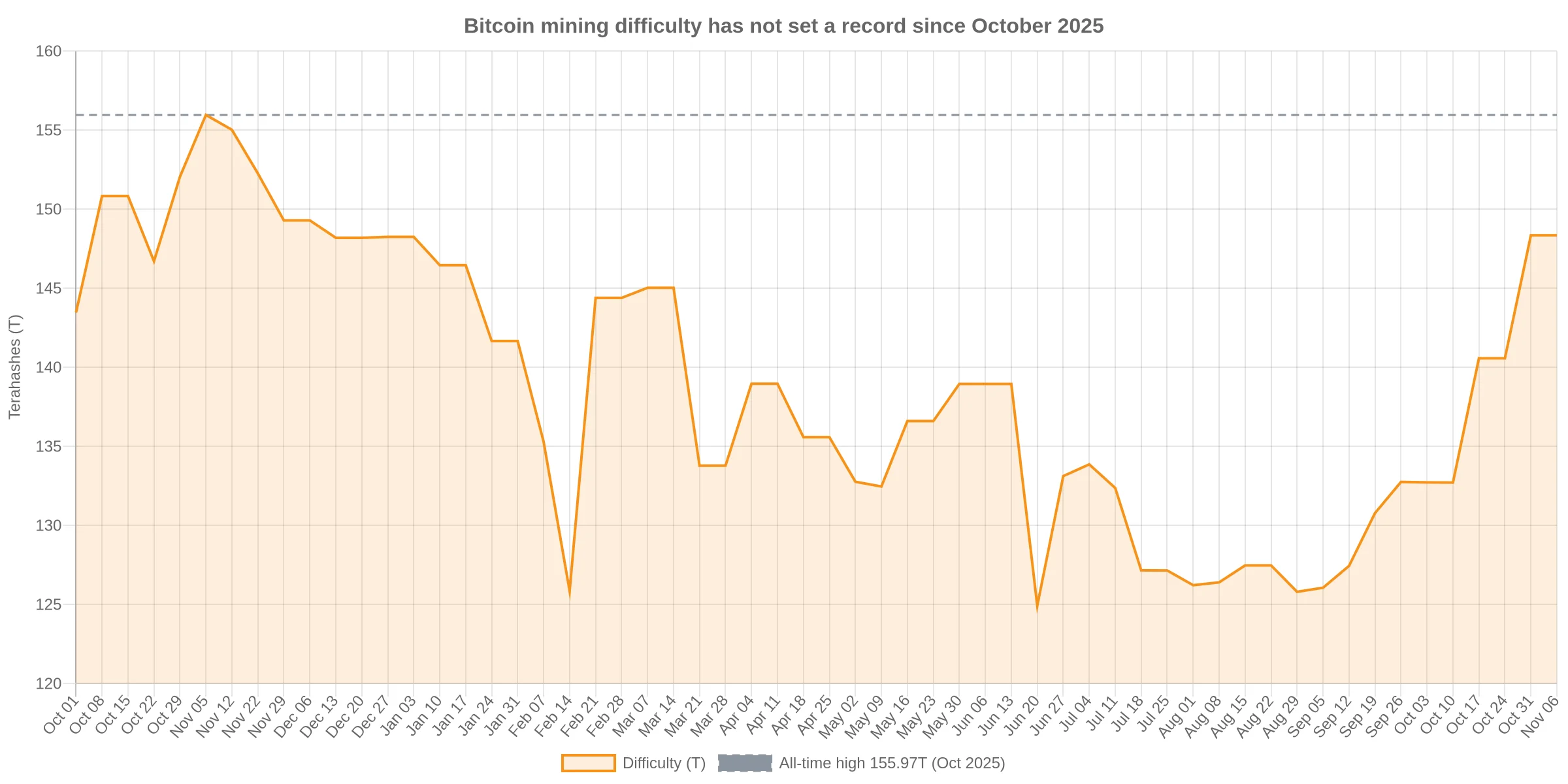
The ratio the company did not publish is the one that explains the 8%: coins mined per unit of hashrate. At 36.0 EH/s and 7,253 coins, CleanSpark produced about 201.5 bitcoin per EH/s of average hashrate. Reconstructing fiscal 2025 from the stated percentages gives roughly 7,884 coins at about 45.6 EH/s, or 173.0 per EH/s. Output per unit of hashpower rose 16.5% year over year even as the network got harder, which is the same efficiency story told in how the biggest listed bitcoin miners actually make money .
That is the quiet argument for the whole strategy. The machines are leaving Sandersville because the power there is worth more sold as data center capacity than as hashrate, not because the mining fleet is failing.
The Valuation Allowance Is the Quietest Line in the Filing
Buried in the tax note, CleanSpark’s valuation allowance against deferred tax assets rose from $3.4 million to $182.5 million in a single year, against $188.6 million of net operating loss carryforwards. A valuation allowance is an accounting judgment that a company does not expect to generate enough taxable income in the relevant window to use those losses.
Management is telling the reader, in the least publicized line of a 10-K, that it does not currently project the taxable profits needed to absorb nearly two hundred million dollars of accumulated losses. That judgment can be reversed in a good year, and it costs nothing in cash. It is also the clearest internal signal in the document about how far out profitability is expected to sit.
What to Watch Into Fiscal 2027
The chairman’s framing of the year was forward-looking by design. “Fiscal 2026 was a defining year for CleanSpark as we made significant progress in executing our strategic transformation,” Matt Schultz said in the release, pointing to contracted opportunities and the capital raised to execute them. Chief financial officer Gary Vecchiarelli described a strategy “centered on disciplined capital stewardship, maintaining flexibility, and allocating capital to opportunities that deliver the strongest risk-adjusted returns.”
The filing’s risk factors are less buoyant. “We have a limited operating history and a history of operating losses and negative cash flow, and we may never achieve consistent profitability,” it states, in a document signed the same day the release described a defining year.
Three things decide whether fiscal 2026 reads as the trough or the turn. First, whether a second data center tenant signs, given that Texas exclusivity has lapsed. Second, whether the Sandersville data hall lands in November 2027, because the $179.2 million coupon does not wait for it. Third, what bitcoin does between now and December 31, because the $319.4 million of mark-to-market damage since year end is sitting in the current quarter, and the same accounting rule that produced the $305.6 million fourth-quarter gain will produce the mirror image of a decline.
Watch cash and contracted revenue. The marks will take care of themselves.
Frequently Asked Questions
Most of it is non-cash. The company recorded a $281.6 million loss on the fair value of its bitcoin and a $118.7 million loss on bitcoin posted as collateral, a combined $400.4 million, plus $177.1 million of impairment on the Sandersville mining site and aged miners, and $428.2 million of depreciation. Revenue fell 24.8% to $576.5 million.
Yes. It mined 7,253 bitcoin in fiscal 2026 at an average hashrate of 36.0 EH/s and ended the year with 13,530 bitcoin including collateral. Mining at the Sandersville site is expected to stop by February 2028 as that capacity converts to data center use, and the company is decommissioning the site during fiscal 2028.
CleanSpark describes it as a 20-year, $6.6 billion triple-net lease with a high investment grade tenant. The tenant is not named in the SEC filing. The build is funded by $2.276 billion of 7.875% senior secured notes due 2031, and the first planned data hall is scheduled for November 2027.
About $179.2 million a year at the 7.875% coupon on $2.276 billion of principal. Fiscal 2026 interest expense was only $11.9 million because the notes were issued on September 25, 2026, six days before the fiscal year closed.
The post CleanSpark’s $987 Million Loss Is Mostly Marks. Sandersville Is the Part That Is Real appeared first on BlockchainReporter .