


FinCEN’s order against MEXC Global binds banks rather than the exchange itself, and that distinction decides who has to change behaviour. The order, signed Friday, bars any covered U.S. financial institution from processing a transmittal of funds from or to MEXC Global, convertible virtual currency included. It rests on a finding that the Seychelles-registered exchange moved at least $16.7 billion connected to illicit finance, including sanctions evasion and cybercrime, between May 2021 and May 2026.
The Treasury’s public announcement puts the figure at “at least $16 billion” and leads with Iran, North Korea and Russia. “Financial institutions cannot have it both ways: Either you support the Iranian regime, or you have access to the U.S. financial system,” Treasury Secretary Scott Bessent said in the release . He added that Treasury “will continue to sever the Iranian regime’s economic lifelines and thwart its desperate attempts to circumvent U.S. sanctions using digital assets”. The order itself is the document that matters for compliance officers, because it defines what a prohibited transfer is, which institutions the ban binds, and when it starts.
What the prohibition covers that a sanctions listing would not
The authority here is section 9714 of the Combating Russian Money Laundering Act, as amended by the 2022 National Defense Authorization Act. It gives the Treasury two routes against a foreign financial institution of primary money laundering concern: impose one of the five special measures written into section 311 of the USA PATRIOT Act, or prohibit and condition “certain transmittals of funds”. FinCEN chose the second route.
The order explains why. Recordkeeping or reporting requirements, it argues, would leave the transfers running. A correspondent-account measure would reach only funds moving through a strict banking relationship, and would leave MEXC able to reach dollars indirectly through foreign institutions. Prohibiting transmittals closes that gap, because it attaches to the payment itself rather than to an account.
Three definitions do the work. A “covered financial institution” takes the meaning already set out in 31 CFR 1010.100(t), the Bank Secrecy Act definition, which reaches regulated intermediaries including banks, brokers and money transmitters. A “transmittal of funds” means “the sending and receiving of funds, including CVC”, a definition the order says overrides the narrower one in section 1010.100(ddd). And “MEXC Global” covers the exchange’s subsidiaries, branches and offices operating outside the United States, plus any successor entity that acquires its assets or carries on its affairs under a new name. Affiliates located inside the United States are expressly excluded.
That structure matters for anyone reading the headline as an asset freeze. The order does not add MEXC to the OFAC list of specially designated nationals, does not block property, and does not tell users to move balances. It tells regulated U.S. intermediaries that a payment touching MEXC is off limits, and it leaves the sanctions framework, including suspicious activity reporting, exactly as it was.
The five-year ledger Treasury assembled
The finding is unusually specific. FinCEN published the categories, the periods and the dollar figures behind each one, and they are not additive because a single transfer can carry more than one label.
| Category | Period | Amount | Detail in the order |
|---|---|---|---|
| Total identified illicit flows | May 2021 to May 2026 | $16.7bn | Sanctions evasion, cybercrime and other illicit activity |
| Russia sanctions-evasion exposure | May 2021 to May 2026 | ~$1.5bn | Includes $232m in direct transactions with U.S., EU or UK sanctioned entities |
| Garantex and Grinex | After the designations | $129m and $4.1m | Transactions continued as recently as June 2026 |
| A7 Network | May 2021 to May 2026 | $26m | Plus almost $200m connected to the A7A5 stablecoin |
| Iran exposure | May 2021 to May 2026 | $1.87bn | Over $1bn direct with more than 40 Iranian exchangers |
| Central Bank of Iran and IRGC | May 2021 to May 2026 | $22m | Sanctioned by the U.S., EU, UK or a combination |
| Al-Qassam Brigades and Iran-linked groups | May 2021 to May 2026 | $36m | Transactions to or from MEXC |
| DPRK facilitator Sim Hyon Sop | June to September 2025 | $350,000 | More than two years after his designation |
| Cybercrime-linked funds | May 2021 to May 2026 | $1.99bn | Ransomware, scam proceeds and stolen funds |
| Ransomware payments received | January 2022 to July 2024 | $37.9m | Exposure to more than 125 ransomware variants |
| Four UK-sanctioned exchangers | May 2018 to July 2026 | $13bn | Cumulative direct transactions |
| Russian darknet markets | September 2020 to July 2026 | $8.5m | Markets known for illicit goods and services |
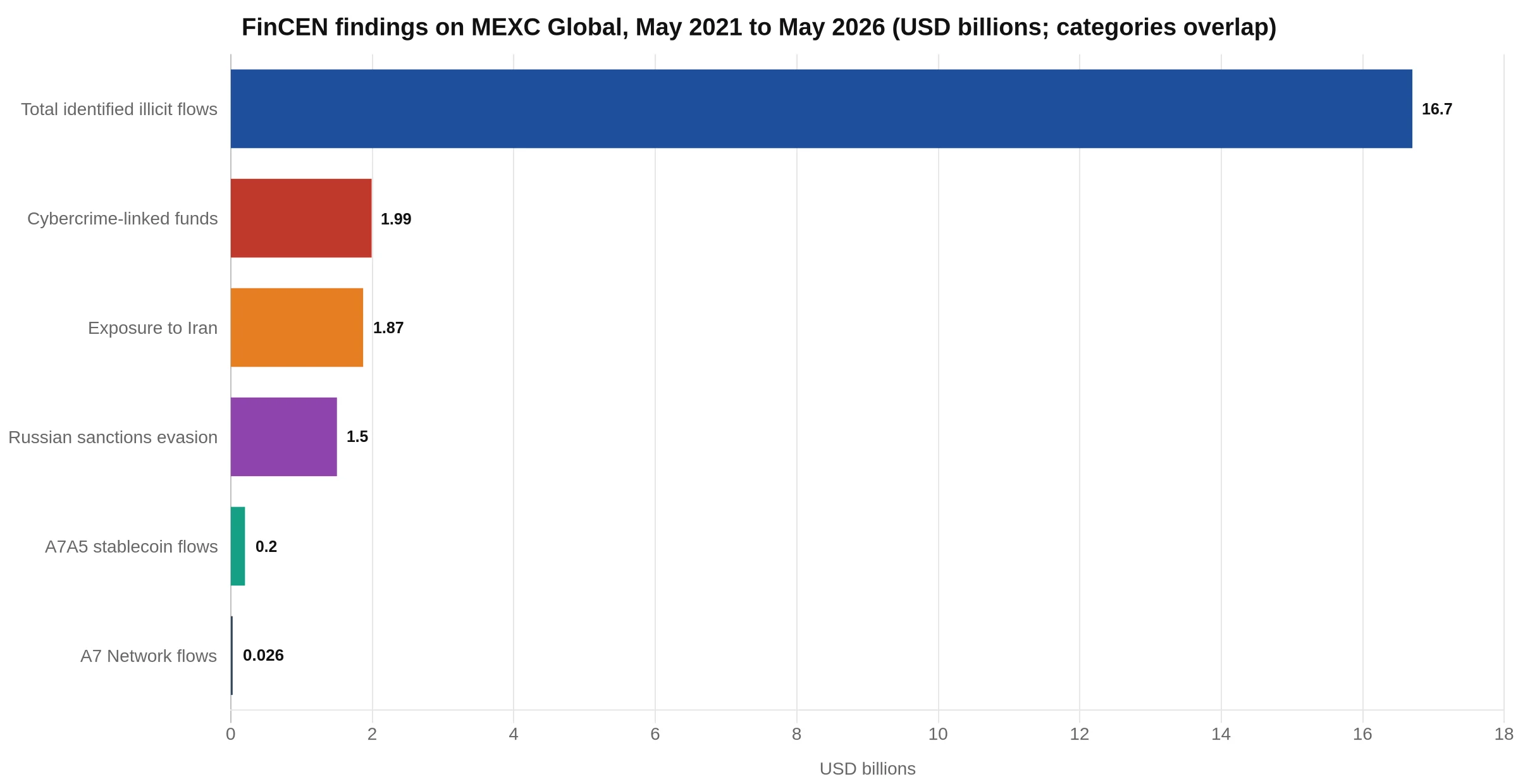
Two readings of the same number are possible, and they point in different directions. Measured against five years of throughput, $16.7 billion spread across the 1,856 days from 1 May 2021 to 31 May 2026 works out to roughly $9 million a day, just under 0.9% of the “more than $1 billion in daily transactions” the order attributes to the exchange as of June 2026. Measured as a lump, it equals about sixteen days of that daily volume, accumulated over five years.
The second reading exposes a tension in the document itself. The Russia-linked bucket, roughly $1.5 billion, is about 9% of the total identified illicit figure, and the $232 million of direct exposure to sanctioned entities is about 15.5% of that bucket. The Iran exposure alone is larger at $1.87 billion, and cybercrime-linked funds are larger again at $1.99 billion. On the arithmetic, the Russian finding is the smallest of the three headline categories.
Garantex, four years after Garantex
The strongest single fact in the order is a date comparison. OFAC designated Garantex in April 2022, in the same action that sanctioned Hydra, the darknet market. Grinex, the successor vehicle, was set up by Garantex staff to keep funds moving after that designation. FinCEN says MEXC processed about $129 million with Garantex and $4.1 million with Grinex after those public designations, and was still transacting with both as recently as June 2026.
That sequence removes the usual defence in sanctions cases, which is ignorance. A designation is public, the successor entity’s purpose was documented, and the flows continued for four years. FinCEN leans on the point, noting that the exchange also processed transfers in violation of its own user agreement, including direct transactions with sanctioned actors operating from jurisdictions the platform lists as prohibited.
The A7 thread runs the same way. The order ties $26 million to the A7 Network, the payments structure built around Ilan Shor and Promsvyazbank, and almost $200 million to A7A5, the ruble-backed token issued on Tron and Ethereum. BlockchainReporter covered the Treasury sanctions on the A7 shadow banking network in October. MEXC’s A7A5 exposure is the piece that connects that designation to a live exchange order book.
A Russia statute carrying an Iran and cybercrime docket
There is a fair question about fit. Section 9714 is a Russia statute, and the finding it requires is that an institution is of primary money laundering concern “in connection with Russian illicit finance”. The press release, meanwhile, spends its first sentence on Iran, North Korea and Russia together, and the order’s largest categories are Iran exposure and cybercrime.
The legal answer is that the Russian nexus carries the authority and the other findings supply the scale. FinCEN finds the Russian link first, through Garantex, Grinex, the A7 Network and the A7A5 token, then treats the Iran, DPRK and cybercrime flows as parallel conduct that informs how severe the remedy should be. A different administration, or a court, could test whether that framing stretches the statute. Nothing in the record suggests MEXC has mounted that argument, and the company had not published a public response that BlockchainReporter could retrieve at the time of writing.
FinCEN also concedes a limitation in its own reasoning. It “assumes that a portion of MEXC Global’s business activities are legitimate”, then concludes that any legitimate business “is outweighed by the risks posed by MEXC Global’s facilitation of illicit activity”. That is a judgement about proportionality, not a finding that the platform has no lawful use. It is the sentence a lawyer would attack first.
The rejection clause is where compliance gets hard
Blocking an outbound payment is straightforward. Refusing an inbound one is not, because a blockchain transfer settles whether or not the recipient wants it. That asymmetry is where the order’s practical bite sits, and FinCEN wrote it into the text rather than leaving it to guidance.
FinCEN says so directly. It acknowledges “technological limitations that may limit or preclude covered financial institutions from declining CVC transfers originating at addresses outside of their control”, and accepts that a compliant institution may end up holding funds sent from MEXC despite trying to avoid the exposure. The order therefore builds in discretion: a bank may act on the facts where, for example, the transfer originated at MEXC but sat for an extended period in an unhosted wallet, or where its own risk procedures would prevent returning funds to the exchange.
In practice, that converts a binary rule into a risk judgement that has to be documented. A U.S. exchange or payment processor receiving a deposit from an MEXC-linked address is not deciding whether to accept it. It is deciding whether to freeze it, return it, or report it, and the order gives it room to choose as long as the reasoning holds. The same section leaves suspicious activity reporting obligations untouched, so a rejection does not close the file. This is the same pattern FinCEN used when it withdrew the 2020 unhosted wallet rule in October and pushed reporting duties back onto existing Bank Secrecy Act channels.
The clock starts in the Federal Register, not on Friday
The order is not in force. The text released Friday carries the placeholder “INSERT 30 DAYS AFTER THE DATE OF PUBLICATION IN THE FEDERAL REGISTER”, and as of Friday evening the FinCEN special measures table listed MEXC Global with an 11/06/2026 entry while the Federal Register’s own search returned no matching document. Until publication, the 30-day clock has not started.
Whenever it does start, there is no end date. The order states that the terms are effective 30 days after publication “with no cessation date”, and FinCEN reserves the right to attach conditions or grant exemptions later. The procedural record also shows the order cleared interagency review: drafts went to the Justice Department, State, the Federal Reserve, the FDIC, the SEC, the CFTC, the OCC and the NCUA, and none objected.
What the licensing record adds
The order does not rest on U.S. law alone. It cites three regulators that found MEXC operating without a licence: the Seychelles Financial Services Authority, which took enforcement action against MX Global Ltd in May 2026; the Hong Kong Securities and Futures Commission, which warned the public about the platform in March 2024; and Japan’s Financial Services Agency, which listed it among suspicious trading platforms in 2023. The order notes that the exchange is incorporated in the Seychelles without a virtual asset service provider licence and operates in more than 170 countries.
Market share gives the action its weight. FinCEN puts MEXC at roughly 9% of global centralized exchange volume as of December 2025, against 47.4% for the two largest venues combined. An exchange of that size sitting outside every major licensing regime is the structural problem the order is designed to price.
The signals that will show whether it bites
The first observable is mechanical. When the Federal Register publishes the order, the effective date becomes fixed and U.S. institutions have a hard deadline to update screening. Until then, compliance teams are working from a document that is final in substance but not yet operative.
The second is the exchange’s own response. A statement promising remediation would not lift the order, which has no cessation clause, but it would shape how counterparties treat the platform in the meantime. Silence leaves every partner to make its own risk call.
The third is where dollars stop moving. Payment processors, over-the-counter desks and custodians that touch U.S. rails have to decide whether an MEXC-linked address is a hard block or a case-by-case review. Their choices, not the Treasury’s press release, determine how much friction a user actually meets.
The fourth is whether other regulators copy the template. The UK has already sanctioned at least four exchangers for facilitating Russian sanctions evasion, according to the order, and a coordinated move across the UK, EU and Japan would matter more than any single national action.
The evidence supports a narrower conclusion than the headlines suggest. Treasury has built a documented case that one large exchange kept processing flows for designated actors years after those actors were named, and it has chosen a remedy that binds U.S. intermediaries rather than the exchange itself. Whether that severs access or merely reroutes it depends on how the rejection clause is applied in practice, and that record will not exist until the order is in force.
Frequently Asked Questions
This action is a FinCEN order under section 9714 of the Combating Russian Money Laundering Act, not an OFAC designation. MEXC Global is not added to the SDN list by this order, no property is blocked, and OFAC sanctions obligations are unchanged.
Thirty days after publication in the Federal Register. FinCEN released the text on 6 November 2026 with that date left as a placeholder, and the Federal Register had not published the order as of that evening, so the 30-day clock had not started.
The prohibition binds covered U.S. financial institutions, not individual users. It does not require anyone to move balances. What changes for a user is the treatment of payments touching the exchange: a bank, processor or custodian may freeze, return or report a transfer involving MEXC once the order is effective.
No. The order states that its terms take effect 30 days after Federal Register publication “with no cessation date”. FinCEN keeps the authority to add conditions or grant exemptions, but the prohibition itself has no sunset.
This article is for information only and is not investment advice.