Riot Platforms booked $181.4 million of revenue in the third quarter and, in the same release, disclosed a 15-year lease over its entire Corsicana campus that it values at about $28 billion. The tenant is described only as “a leading Frontier AI Lab,” and the structure is a triple-net powered land lease: Riot supplies land, high-voltage infrastructure and powered pads, while the tenant buys, owns and runs the computers. That distinction is the story. Riot is not selling artificial-intelligence compute. It is renting dirt, wires and permits, and collecting about $1.8 billion a year for it once the campus is delivered.
The results release filed with the SEC on 4 November puts the contract value at roughly $28 billion over the initial term, or about $54 billion if both five-year extension options are exercised. Riot says the deal covers 910 megawatts of critical IT capacity on a contiguous 332-acre parcel, with rent payable on the full 910 MW regardless of how much of it the tenant actually uses.
A landlord contract wearing an AI costume
The mechanics matter more than the headline number. Under the triple-net structure, Riot delivers the land, the power infrastructure and the powered pads, and keeps ownership and maintenance of the high- and medium-voltage infrastructure that serves them. The tenant procures, installs, owns and operates the modular compute on those pads, and absorbs substantially all operating costs, with power passed through.
That is why the release can claim an estimated net operating income margin of about 99%, or roughly $1.8 billion of average annual NOI over the initial term. A landlord with no electricity bill, no chips to depreciate and no utilisation risk books almost the entire rent as NOI. Jason Les, Riot’s chief executive, framed the structure as the point rather than the scale: “The structure of this new lease matters as much as the scale.”
The capital number is the other half of the pitch. Riot puts total capital cost at about $6 million per IT megawatt, or $5.5 billion across the campus, roughly half the intensity of a typical Tier 3 build, which the company says implies an unlevered yield on cost of approximately 33%. Divide the stated $1.8 billion of average annual rent by the $5.5 billion build and you get 32.7%, so the company’s arithmetic holds.
Riot’s own cheque is smaller than one year of rent
The split of that capital is where the leverage sits. Riot funds $2 million per IT megawatt for site work and electrical infrastructure, or about $1.82 billion across 910 MW. The remaining $4 million per megawatt, roughly $3.64 billion, is reimbursed to the tenant in phases after each phase is delivered and paying rent.
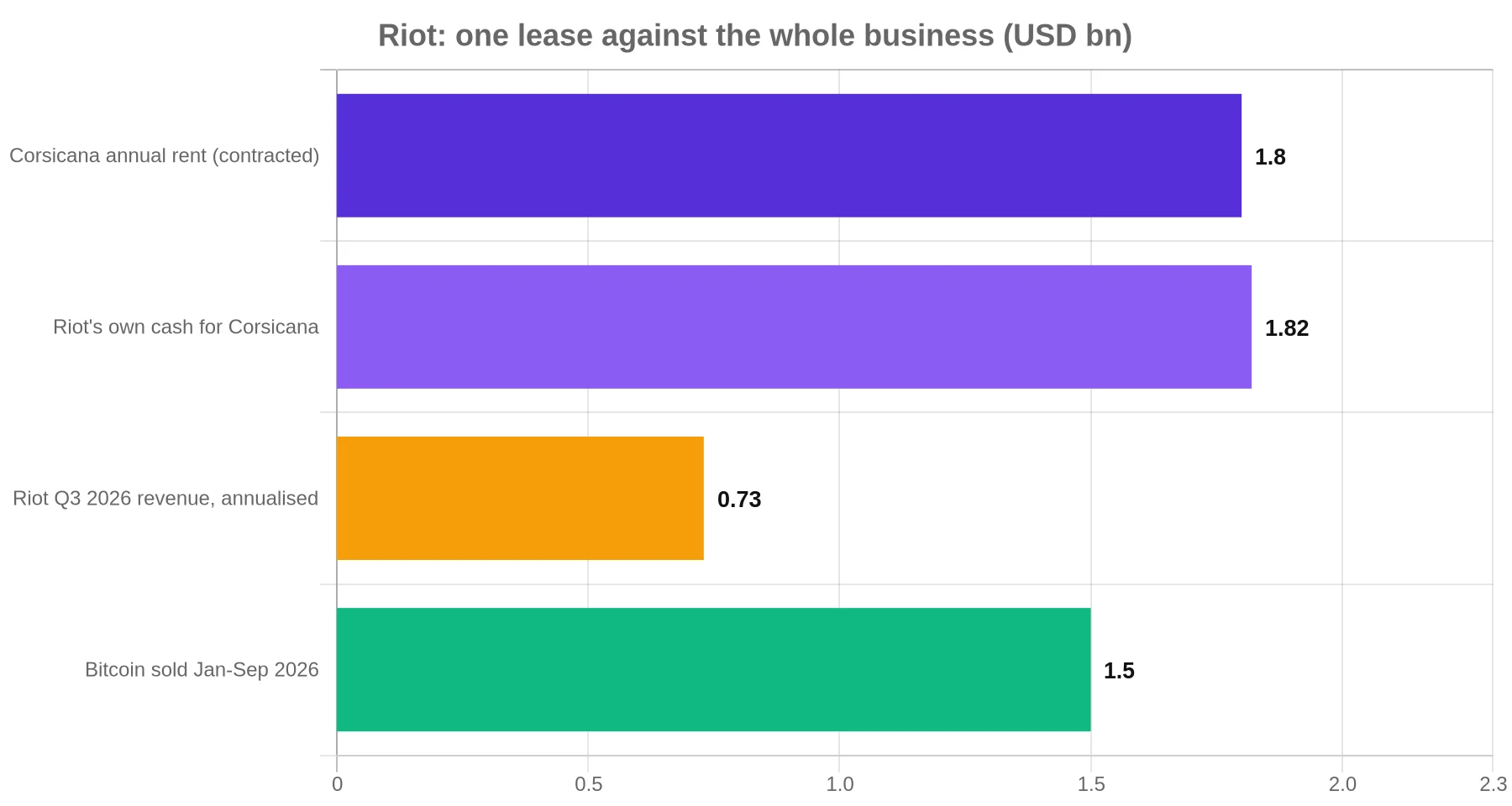
Set the two figures side by side and the deal’s shape becomes obvious: Riot’s own outlay of about $1.82 billion is almost exactly one year of contracted rent at $1.8 billion. Phases arrive on a schedule — 400 MW in September 2027, 200 MW in January 2028 and 310 MW in July 2028 — with rent on each phase starting no later than 60 days after its powered pads are handed over. The cash comes back quickly relative to the build, which is why Les told investors: “That lower capital requirement, combined with our strong balance sheet, means that we do not currently anticipate issuing equity to fund our announced projects.”
The financing carries a condition that deserves attention. Riot expects the tenant reimbursements to be funded with non-recourse project debt sized to contracted rent. If financing on comparable market terms is not available, the tenant funds the reimbursements directly and recovers them as a credit against rent over the remaining lease term. In that scenario Riot still gets its campus built, but the rent stream is reduced for years, and the release does not quantify by how much.
The tenant Riot will not name
Neither the earnings release nor the 8-K body names the counterparty. The text says “a leading Frontier AI Lab” throughout, and a full-text search of the filing finds no mention of Anthropic, which several outlets reported as the tenant on the same day. That identification is press reporting, not something Riot has confirmed in the document investors can read.
The omission is not cosmetic. A 15-year, $28 billion rent obligation is only as good as the balance sheet behind it, and the filing gives no counterparty credit detail, no guarantee structure and no parent-company backstop. What it does give is a concentration fact: the entirety of Corsicana, Riot’s largest site, is leased to one unnamed tenant. If that tenant walks or fails, Riot is left holding powered pads built for modular AI compute, a category of real estate that is valuable today and unproven across a downturn.
Bitcoin mining is now the smaller half of the business
The quarter shows the pivot in the revenue line. Total revenue was $181.4 million against $180.2 million a year earlier, a 1% increase that hides a large internal rotation. Bitcoin mining revenue fell to $116.0 million from $160.8 million, a $44.8 million, or 27.9%, decline, driven mainly by the average bitcoin price of $70,855 in the quarter against $114,361 a year earlier. Engineering revenue more than doubled to $47.0 million from $19.1 million, and data center revenue reached $18.4 million, including $7.7 million of base rent and $10.2 million of tenant fit-out reimbursement from the first full quarter of the stabilised 25 MW delivered to AMD.
Put the non-mining pieces together and they produced $65.4 million, or 36.1% of quarterly revenue. Engineering alone was 10.6% of revenue a year earlier. The company that mined 1,637 bitcoin in the quarter is increasingly an electrical contractor and a landlord that also mines. It is the same pivot that Galaxy Digital made in its own third quarter , where data center income and treasury marks covered a softer trading book.
Mining itself got cheaper. The average cash cost to mine a bitcoin, excluding depreciation, fell to $39,265 from $46,324, helped by $24.7 million of power curtailment credits, equivalent to $15,067 per coin mined, or about 38% of the stated cash cost. Against the release’s average bitcoin price of $70,855, that spread is roughly $31,600 per coin, or about $51.7 million of gross mining margin before depreciation on the quarter’s production. For comparison, American Bitcoin’s quarter showed the same pattern of mining economics being overwhelmed by balance-sheet items.
The treasury moved in the opposite direction from the strategy. Riot sold 20,264 bitcoin in the first nine months of 2026 for about $1.5 billion, an average of roughly $74,000 per coin by our calculation, primarily to fund data center development. It ended September with 2,418 bitcoin and $950.2 million of cash and bitcoin combined, including $748.2 million of cash, $79.2 million of it restricted. At a bitcoin price near $76,200 on 5 November, that stack is worth about $184 million, below the $202.0 million the release marks it at for 30 September.
What the $38 billion number does not promise
Riot now has 1,151 MW of critical IT capacity leased, carrying approximately $38 billion of long-term contracted revenue, which the company expects to generate more than $2 billion of average annual NOI at full deployment. Subtract the Corsicana contract and roughly $10 billion sits across the remaining 241 MW, which includes the earlier Rockdale lease with the same tenant and the 25 MW AMD deployment, so the figure cannot be pinned to one agreement.
Across the whole portfolio, the blended contract value works out to about $33.0 million per megawatt; Corsicana alone is $30.8 million per megawatt on our arithmetic, slightly below the blend. The release also presents $28 billion over 15 years as an average of about $1.8 billion a year including escalators, while straight division gives $1.87 billion, consistent with rent starting below the average and stepping up.
None of that revenue exists yet in the income statement. Delivery runs into the second half of 2028, the rent clock starts after each phase is handed over, and the reimbursement structure depends on project finance that has not been raised. What Riot has sold is a contract, and the market will spend the next two years pricing the execution risk between signature and first full rent cheque.
There is a second, quieter exposure: the data center business is being built to escape bitcoin mining economics, but Riot still holds 2,418 bitcoin and still sells coins to fund construction. A weaker bitcoin price does not touch the rent, but it does touch the liquidity Riot says it will use for its $2 million per megawatt contribution. Les was explicit that capital allocation will follow value per share: “As these significant contracted cash flows come online, we will allocate our capital with discipline to whichever use creates the most value per share, whether that is our development pipeline or returning capital to shareholders.” That is a promise about a period that begins in 2027, not a description of the quarter just reported.
Frequently Asked Questions
Riot’s SEC filing describes the counterparty only as “a leading Frontier AI Lab” and does not name it. Press reports on 4 November identified the tenant as Anthropic, but that identification does not appear in the earnings release or the 8-K text, so it remains unconfirmed by the company.
Riot plans to deliver 400 MW in September 2027, 200 MW in January 2028 and 310 MW in July 2028. Rent on each phase begins no later than 60 days after the powered pads for that phase are delivered, so full rent on 910 MW arrives only after the final phase in 2028.
Yes. Riot sold 20,264 bitcoin in the first nine months of 2026 for about $1.5 billion, primarily to fund data center development, and ended September with 2,418 bitcoin plus $748.2 million of cash. The company says it does not currently anticipate issuing equity to fund announced projects.
It is a lease in which the tenant pays rent plus substantially all operating costs (power, maintenance and taxes on its own equipment) while the landlord provides land and the powered infrastructure. Riot keeps ownership of the high- and medium-voltage systems, the tenant owns the compute, and rent is due on the full 910 MW whether or not the tenant uses it.
In the third quarter of 2026, bitcoin mining produced $116.0 million of $181.4 million in total revenue, or about 64%. Engineering contributed $47.0 million and data center operations $18.4 million, so non-mining segments accounted for 36.1% of the top line.
Data: Riot Platforms Q3 2026 release (SEC Exhibit 99.1) , SEC EDGAR filings , Binance BTC/USDT . Bitcoin price quoted at 17:12 UTC on 5 November 2026.
This article is for information only and is not investment advice. Prices, levels and market data are a point-in-time snapshot and can change at any moment.