Introduction
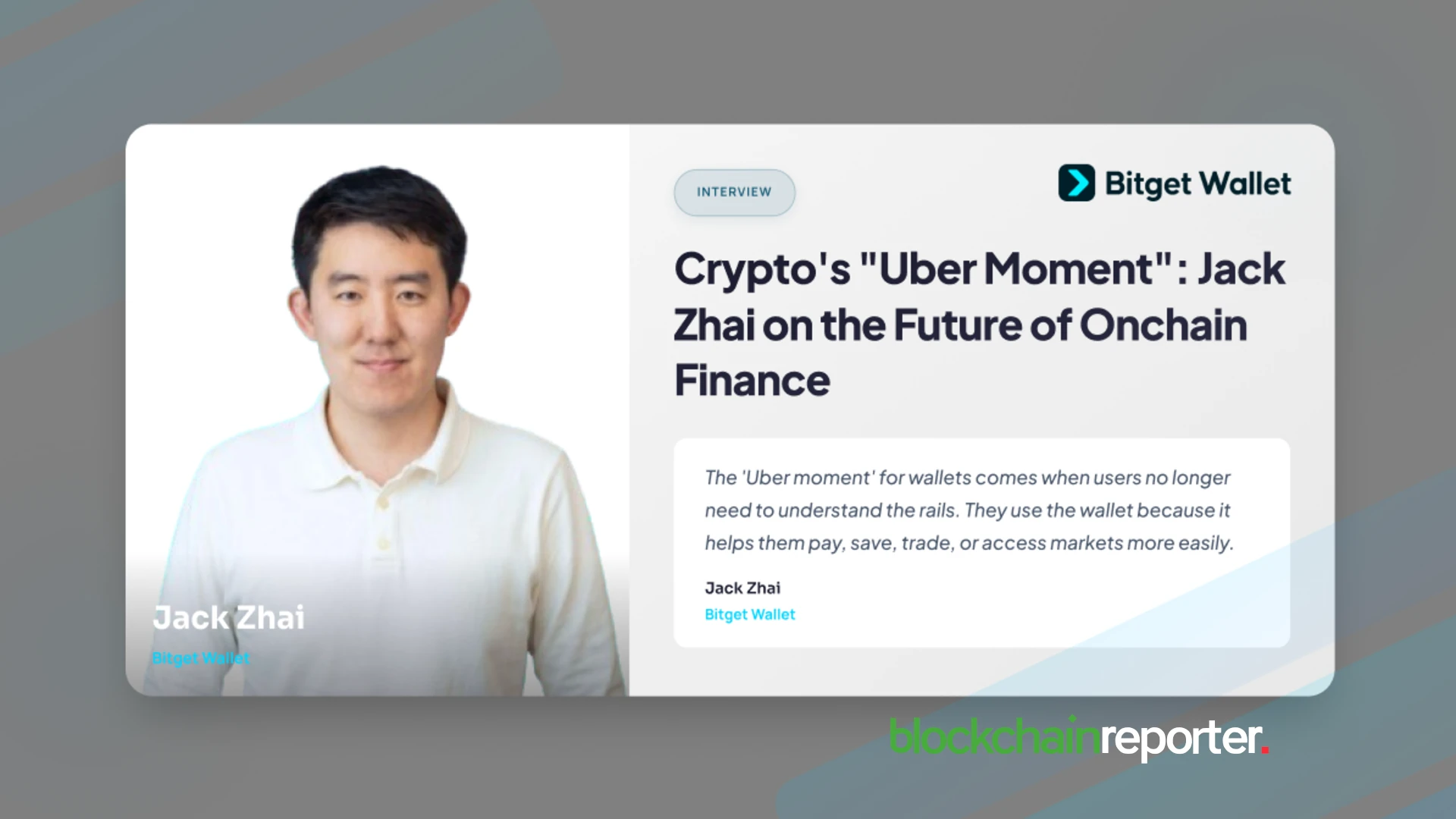
In an exclusive interview, we sat with Jack Zhai, the executive at Bitget Wallet . He shared his perspective with BlockchainReporter that how the next phase of crypto adoption is shifting toward real-world usability, simplified financial access, and mainstream onboarding.
Relating his experience at Uber and NewsBreak, he described crypto’s current evolution as entering an “Uber moment,” where complex blockchain infrastructure gradually disappears behind seamless, everyday user experiences. During the discussion, Jack Zhai explains self-custodial finance, stablecoins, AI-driven wallet experiences, and Bitget Wallet’s strategy for expanding adoption across North America and Latin America.
Interview Section
What is Bitget Wallet’s strategy to serve as an everyday financial interface for consumers in America?
The strategy is to make self-custodial finance useful beyond trading. A wallet should help users access stablecoins, tokenized assets, payments, yield, and onchain markets from one simple interface.
In America, the use cases differ by market. In North America, users already have mature banks and fintech apps, so the value is stronger ownership, broader market access, and safer onchain experiences. In Latin America, wallets can address more immediate needs such as digital dollar access, remittances, and payment friction.
Our focus is to localize around real user needs while making the product simple enough for daily use.
What inspired you to become a part of Bitget Wallet after leadership roles at NewsBreak, Uber, and other Web3 ventures?
I have always been drawn to moments when technology moves from early adopters into daily life. At Uber, a complex system of drivers, maps, payments, and local operations became one button. At NewsBreak, localization and distribution turned information into a daily habit.
Around 2018, I began seeing blockchain as the next major technology shift. After working with Web3 projects, I felt wallets were more durable than many token narratives because they are where users actually interact with crypto. Bitget Wallet stood out because it has the scale and product depth to make crypto practical across payments, trading, stablecoins, yield, and onchain access.
As you consider crypto to be entering the “Uber moment,” what analogies do you witness between the growth of the ride-sharing entity and the mainstream crypto wallet adoption?
Uber became mainstream by hiding complexity behind a simple outcome: getting from one place to another. Users did not think about routing, driver matching, payments, or local operations. They just opened the app and moved.
Crypto needs the same transition. Today, users still see too much of the backend – chains, gas, bridges, approvals, and risks. That makes crypto feel like infrastructure rather than a product. The “Uber moment” for wallets comes when users no longer need to understand the rails. They use the wallet because it helps them pay, save, trade, or access markets more easily.
How will the experience in scaling Uber during the platform’s international growth assist you in driving Bitget Wallet’s expansion in the US?
Uber taught me that expansion is local problem-solving. A product only scales when it fits local regulations, payment habits, trust barriers, and user expectations.
That matters in the U.S. because users already have strong banks, payment apps, and brokerages. Bitget Wallet has to offer something distinct: self-custody, open onchain access, tokenized assets, stablecoin utility, and stronger user control.
The U.S. is also a trust market. Users are sophisticated, regulators are active, and the media environment is demanding. Growth here depends on credibility, security, education, and practical use cases, not just early adoption.
What are the top opportunities for different self-custodial wallets while users increasingly look for alternatives to conventional banking systems?
The opportunity is not to build a bank with a crypto label. It is to offer what conventional finance often cannot: user ownership, borderless access, and open market connectivity. Self-custodial wallets can give users control over their assets and access to tools that are not locked inside one platform, including stablecoins, tokenized assets, DeFi, prediction markets, and cross-border payments.
But ownership alone is not enough. The next phase will be defined by wallets that make open finance easier and safer for everyday users, not just more powerful for experts.
How can Bitget Wallet streamline blockchain-based payments, on-chain finance, and stablecoins for daily users?
The key is to stop making users assemble the experience themselves. A simple action should not require choosing a chain, finding gas, bridging assets, and signing multiple transactions.
Bitget Wallet brings more of that into one interface. Social login makes onboarding familiar, gas abstraction reduces the need to manage native tokens, and users can hold stablecoins, swap, transfer, access DApps, earn yield, and move across chains with less friction. We are also expanding payment flexibility. As more assets are supported, users will be able to spend more types of tokens directly through Bitget Wallet beyond stablecoins, without manually swapping them.
What is your opinion on the role of stablecoins in redefining payments across borders and wider financial inclusion across North America and Latin America?
Stablecoins turn crypto into something people can understand: digital dollars that move across borders. They can support remittances, freelancer payments, merchant settlement, payouts, trading, and access to dollar-denominated value.
In Latin America, stablecoins often solve immediate needs around currency volatility and cross-border transfers. In North America, they may grow more through settlement, merchant payments, trading, and onchain financial applications.
But stablecoins will not redefine payments just because they are faster. They need wallets, local payment access, regulated partners, and simple user experiences. Wallets are the layer that makes stablecoin infrastructure usable for people and businesses.
With more than 90M users worldwide, what is Bitget Wallet’s plan to advance adoption within the US?
The U.S. already has mature financial products, so adoption depends on showing what self-custodial onchain finance adds that existing apps do not.
Our focus is access, usability, and trust. Access means helping users reach stablecoins, tokenized assets, trading opportunities, prediction markets, yield, and onchain applications from one interface. Usability means reducing friction through social login, gas and chain abstraction, AI guidance, and simpler transaction flows. Trust means strong security design, education, and transparent risk controls. We also want to build with local partners, developers, and communities so the product is credible and useful beyond market cycles.
With a comprehensive experience in Web3, consumer technology, and AI, what is your viewpoint on AI in improving DeFi and crypto wallets?
AI can make crypto easier to understand, but it should not become a black box that makes decisions for users. The value is guidance, since DeFi is powerful but difficult. Users need to compare routes, understand risks, manage approvals, read market signals, and avoid bad contracts. AI can organize that complexity into clearer choices: explaining a transaction, surfacing risks, finding better routes, or helping users understand a market before they act.
For wallets, AI will become part of the interface. Users can express intent, while the wallet helps guide execution. Permissions and control must stay with the user.
What is Bitget Wallet’s approach to balaning consumer-friendly experiences with resilient privacy and security benefits that self-custodial wallets provide?
Self-custody gives users control, but it also gives them responsibility. For mainstream users, seed phrases, gas tokens, approvals, bridges, and fragmented networks can become barriers. Our goal is simple: easier to start, smoother to use, safer by default.
Bitget Wallet reduces the burdens without taking ownership away. Social login makes onboarding familiar, while TEE-based security protects private key operations so users can remain self-custodial. Gas abstraction reduces the need to manage native tokens across chains. Security is built around prevention: transaction simulation, risk alerts, approval management, MEV protection, and smart contract detection help users identify risks before they act.
Conclusion
Jack Zhai’s insights show a clear direction for the future of crypto: simplicity, accessibility, and real utility. He foresees that the next wave of adoption will not come from technical complexity, but from user-focused design that removes friction from blockchain interactions.
Bitget Wallet has positioned itself as the gateway to stablecoins, tokenized assets, and onchain finance. The emphasis remains on combining self-custody with usability and security. From AI-assisted DeFi navigation to seamless cross-border payments, the vision centers on making crypto feel less like infrastructure and more like an everyday financial tool.