


What Is MegaETH?
MegaETH is an Ethereum Layer 2 blockchain built around one obsession: raw speed. The network targets 100,000 transactions per second with 10-millisecond block times, numbers that put it closer to a centralized exchange backend than a typical rollup. It runs a heterogeneous node architecture, meaning sequencers, full nodes, read replicas, and provers each specialize in a single job rather than doing everything badly. The result is an EVM-compatible chain where latency-sensitive apps like high-frequency trading, fully on-chain games, and real-time NFT minting can actually function without batching their way into a 12-second wait.
The project raised $107.68 million in total funding across a $20 million seed round led by Dragonfly Capital in June 2024 (Vitalik Buterin and Joseph Lubin both participated), a $10 million community round on Echo in December 2024, and a public token sale in October 2025 that hit its $49.95 million cap and came in roughly 9x oversubscribed with 14,491 participating wallets. The MEGA token generation event completed November 5, 2025. The mainnet launched publicly in April 2026, and Season 1 incentives are now running.
Why We Expect a Continued Airdrop
The airdrop is not speculative at this point. It is confirmed and active. Here is the specific breakdown.
The Fluffle NFT allocation (5% of total supply) was distributed to holders of a 10,000-piece soulbound NFT collection minted in February 2025. That window is closed. However, an additional 2.5% of the total 10,000,000,000 MEGA supply is explicitly earmarked for mainnet campaign participants and ecosystem app users. Season 1 runs from April 28 to June 23, 2026, eight weeks of on-chain activity that feeds directly into that allocation. Post-season, rewards are distributed based on activity level, with KYC and sanctions screening applied.
The whitepaper filed under MiCA regulations states that MEGA tokens are intended for “ecosystem incentives” alongside gas fee payments, staking, and governance. The structure mirrors well-precedented playbooks: lock in retroactive users through NFT-based allocations, then sustain engagement with activity-based campaigns. Dragonfly-backed projects have used this two-phase approach before (dYdX, Blur). We have no reason to expect the additional 2.5% to be the last allocation tranche either. Season 2 is almost certainly coming.
How to Farm: Step by Step
Before you start: You will need a wallet with some ETH on Ethereum mainnet (or another supported chain) for bridging. Budget $5-15 in gas and bridge fees total for a basic setup. This is a mainnet chain, not a testnet. Every interaction is real.
1. Set up your Terminal profile
Go to the MegaETH Terminal and connect your wallet plus your X (Twitter) account. The first wallet you connect becomes your Main Wallet and serves as your profile ID. Additional wallets added later become sub-wallets that share the same profile and its boosters.
Sybil tip: Do not connect multiple wallets from the same IP or with the same X account. The Terminal profile system explicitly links wallets to a social identity, so duplicate profiles are easy to detect. One clean profile beats five flagged ones.
- Gas: ~$0.50-1 for the initial on-chain transaction
- Time: 5 minutes
2. Bridge ETH to MegaETH
Use the built-in bridge on Rabbithole, MegaETH’s official ecosystem frontend. You can also use a centralized exchange withdrawal directly to MegaETH if your exchange supports it. Bridge at least $50-100 worth of ETH to have room for multiple app interactions without running dry.
- Gas: ~$3-8 depending on Ethereum mainnet congestion
- Time: 10-20 minutes including bridge finality
Sybil tip: Use a distinct amount when bridging (e.g., $73.41 rather than a round $50). Round-number bridges are a common clustering signal in sybil analysis.
3. Acquire USDm
USDm is MegaETH’s native yield-bearing stablecoin and the fuel for most ecosystem apps. Swap ETH for USDm via the Rabbithole Swap feature or purchase directly on Kumbaya. Holding USDm in your wallet also signals genuine ecosystem participation rather than one-and-done behavior.
- Gas: Near-zero on MegaETH (sub-cent)
- Time: 2 minutes
4. Interact with featured apps weekly
The Terminal highlights three apps each week and resets every Tuesday at 12am UTC. Some apps earn points; others are listed for discoverability only. Read the labels carefully before spending time. Our current rotation includes:
- Prism – Swap tokens or provide liquidity. This is the core DEX activity and the easiest to repeat weekly.
- GMX – Trade perpetuals or provide liquidity for yield. Higher capital requirements but counts as meaningful DeFi activity.
- HitOne – Leveraged trading up to 1000x. The leverage is a product feature, not a recommendation. Use small positions if you are here for points, not speculation.
- Ubitel – Purchase eSIM credits. Low-cost, non-financial, good for demonstrating variety in your activity profile.
Aim to interact with at least 3 different apps per week. Diversification across protocols consistently outperforms concentrated activity in single-app airdrop distributions.
- Gas: Near-zero on MegaETH per transaction
- Time: 30-60 minutes per week
Sybil tip: Do not ape into the same app with 50 wallets doing identical transaction amounts at the same time. Season 1’s weekly cutoff structure makes behavioral clustering trivially detectable.
5. Stack boosters via NFT clan pledging
Six NFT clans are currently available for pledging: Bad Bunnz, WCNetizens, Meganacci, Magalio, MINIMINDS, and Legends of Breadio. Pledging to a clan weekly raises your booster multiplier, stacking up to three NFTs simultaneously. Boosters amplify your weekly base points and sit on top of your activity score, not as a replacement for it. If you own any of these NFTs already, pledge weekly without fail. If you do not, prioritize app interactions first.
- Gas: Near-zero on MegaETH
- Time: 5 minutes per week

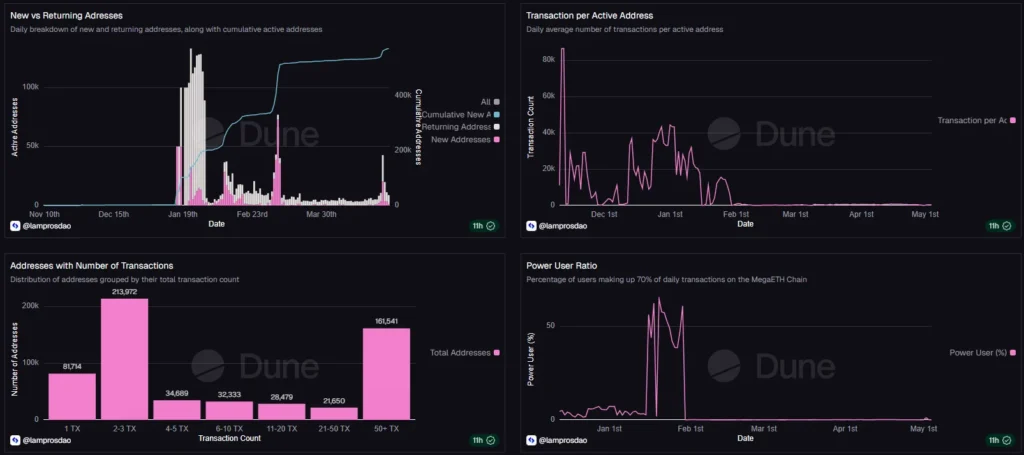
The Dune data tells a useful story here. Over half a million addresses have been active on MegaETH, but the distribution is heavily skewed. More than half touched the chain for a single day and never returned. The 108,072 addresses with 10-15 active days are likely the cohort that a points-weighted system rewards most. We estimate consistent weekly activity through June 23 puts you in roughly the top 20% of participants by engagement duration alone.
Risk Rating: 3 / 5
Airdrop confirmation: Confirmed. The 2.5% mainnet allocation is explicitly stated in official materials, and Season 1 is live with a defined end date. This is not vapor.
Sybil risk: Moderate to high. The Terminal profile system ties wallets to social identities, which is a meaningful anti-sybil measure, but it does not eliminate the problem. On-chain behavioral clustering (same apps, same amounts, same timing across many wallets) is still a real risk for anyone running multi-wallet strategies. The Dune dashboard shows 161,541 addresses with 50+ transactions, a number that suggests automated farming is already present.
Smart contract risk: Standard L2 rollup risks apply. MegaETH uses an Optimistic Rollup design inheriting Ethereum’s security. The codebase is relatively young. Use amounts you are comfortable losing to an exploit.
KYC requirement: Season 1 rewards require KYC and sanctions screening to claim. This is explicitly stated. If you are in a restricted jurisdiction or unwilling to KYC, your points may not be claimable.
Dilution risk: 2.5% of 10 billion tokens equals 250 million MEGA for mainnet activity. With 574,378 active addresses on-chain already, and participation likely growing before the June 23 cutoff, per-wallet allocations could be modest unless boosters and consistency create meaningful separation.
Related Airdrops
If you are farming MegaETH, these guides from our archive are worth reading alongside this one:
- Polymarket Pre-Token Airdrop Activity Strategy
- OpenSea Airdrop Farming Guide: Practical $SEA Strategy
- GRVT Airdrop Farming Guide: Practical Season 2 Strategy