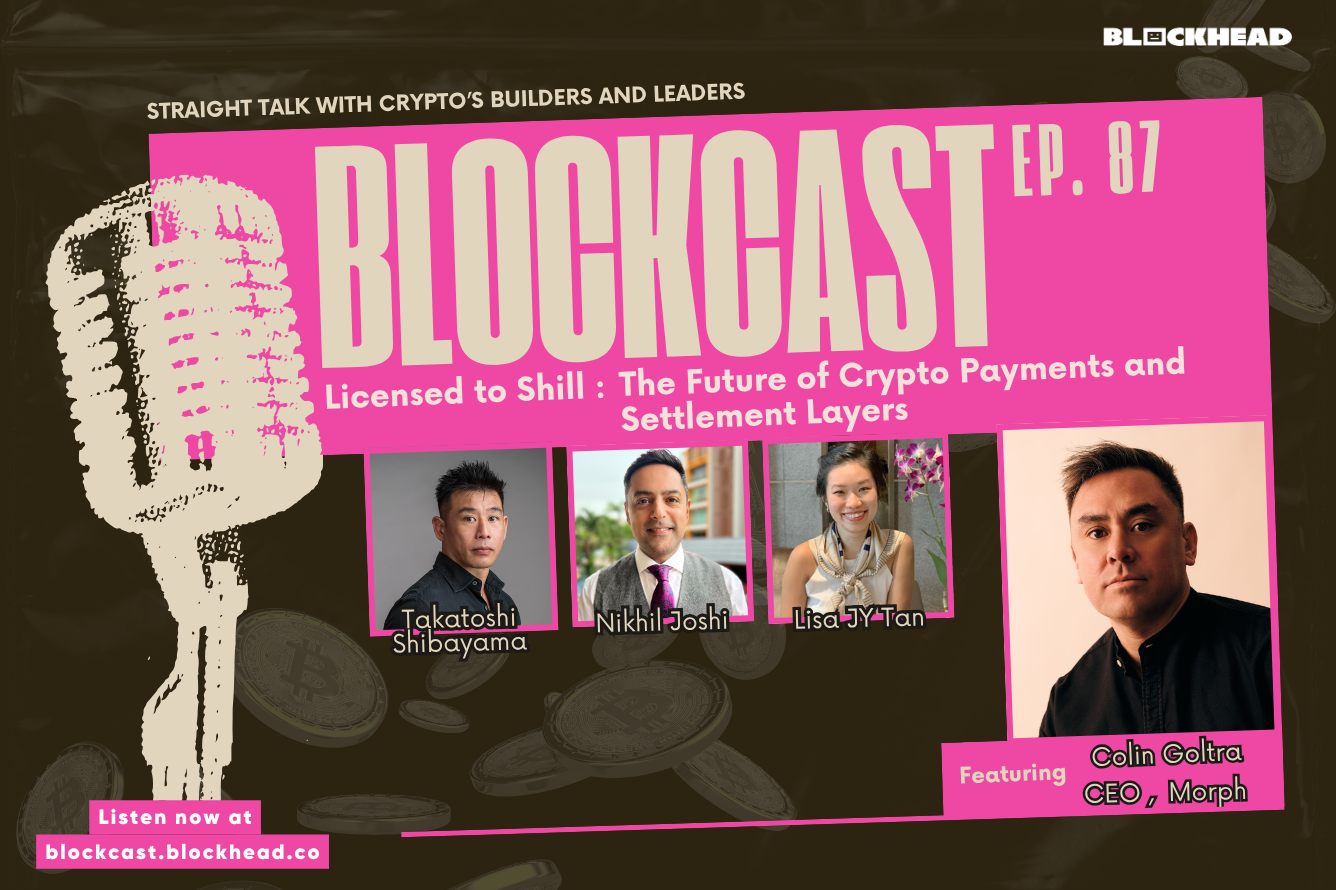
The panel is joined by Colin Goltra, CEO of Morph, to dig into one of the more underexplored frontiers in crypto: the infrastructure that will let AI agents transact autonomously, and what compliance, identity, and economic design look like in that world.
1. What Morph Is Building
Morph positions itself as a payment settlement layer. Where many L2s have pursued general-purpose ambitions, Morph has progressively narrowed toward a specific thesis: stablecoin-optimised financial infrastructure that global businesses, developers, and consumers can build on. Goltra referenced Vitalik Buterin's public reconsideration of the rollup-centric roadmap as context — for Morph, the response was to sharpen its use case focus rather than expand the platform surface.
Stablecoin transaction volume hit roughly $33 trillion last year and is growing at around 72%. Goltra's read: a market that large accommodates multiple chains capturing meaningful share, and payments-native infrastructure carries real advantages over general-purpose alternatives.
2. Privacy, Compliance, and the Enterprise Problem
Onchain settlement creates an immediate tension for enterprise clients: public verifiability sits alongside competitive confidentiality. Businesses are unwilling to expose transaction flows to competitors any more than to regulators they haven't cleared.
Goltra was candid that Morph is mid-rebuild on this front — what he called an "infrastructure renaissance" — bringing in compliance vendors and overhauling for KYT (Know Your Transaction) requirements. On sanctions compliance: it's a prerequisite, treated internally as a P0. Violating sanctions is an existential risk, full stop.
Privacy he sees as a feature and a commercial necessity. The goal is preserving the auditability that makes blockchain useful while shielding commercial data that enterprises need protected.
3. Agentic Commerce: The New Frontier
The conversation's sharpest territory was agentic payments. Morph has launched an ERC-8004 standard — an identity and reputation framework for AI agents — and is betting that autonomous agent commerce is upstream of where enterprise demand will be in 12 to 18 months.
Goltra sketched a progression: agents that answer questions, then agents that monitor and alert, then agents that execute limited transactions on your behalf, and finally fully autonomous agents with their own goal sets. Identity and reputation become critical infrastructure at those last two stages.
The scam vector he flagged was pointed: agents will be highly capable at identifying prior scam victims via on-chain data, constructing targeted fraud at scale, and operating without the moral friction that occasionally slows a human bad actor. Reputation infrastructure serves as a defence mechanism.
A well-regarded agent could also function as a new layer of multi-factor authentication, monitoring for compromised approvals or suspicious contract interactions in real time. An agent, Goltra noted, would have immediately surfaced exposure when Cowswap was exploited — the kind of persistent monitoring that no human can reliably provide.
4. Web2 Agents, Web3 Agents, and the Legal Divide
Lisa JY Tan (Economics Design) pushed on the infrastructure question: do agents need their own chain, or can they use existing infrastructure with guardrails built in?
Goltra came down on the side of open, interoperable systems — and identified the philosophical crux separating Web2 from Web3 approaches. In Web2, every agent must ultimately map to a human counterpart. Legal contracts require a human signatory. An agent acts on behalf of a person, always. In Web3, that constraint dissolves. An agent can sign a smart contract, be launched anonymously, and operate without a traceable human owner — closer to the cypherpunk vision of autonomous code than to a corporate sub-agent.
The distinction shapes what compliance looks like, what "know your agent" means in practice, and whether the emerging machine economy runs parallel to human finance or through it.
5. The Long Tail: Prediction Markets and the Unit of Account
The episode's most speculative exchange was also its most interesting. Asked about the biggest unsolved problem in agentic payments that nobody is discussing, Goltra pointed to prediction markets.
His argument: money functions as stored optionality — a claim on future choices in the face of uncertainty. In a world with highly liquid prediction markets, agents capable of synthesising information at scale could shift what that optionality is worth, and what form it should take. If an agent can weight your probability distribution across future states, you may want to hold the specific asset most affected by the most likely outcome, rather than a pure-form store of value.
Agents, in this framing, are harvesting compute to surface information, pricing uncertainty in real time, and potentially changing the relationship between humans and the future. That's a long-horizon thesis, and one that sits at the far end of the agentic commerce roadmap.
If you enjoyed this episode, please like and subscribe to Blockcast on your favorite podcast platforms like Spotify and Apple .
Blockcast is hosted by Head of APAC at Ledger, Takatoshi Shibayama . Previous episodes of Blockcast can be found here , with guests like Fredrick Gregaard (Cardano Foundation), Daren Guo (Reap), Yat Siu (Animoca Brands), Kean Gilbert (Lido), Joey Isaacson (Nook), Kapil Dhiman (Quranium) Eric van Miltenburg (Ripple), Davide Menegaldo (Neon EVM), Anastasia Plotnikova (Fideum), Jeremy Tan (Singapore parliament candidate), Hassan Ahmed (Coinbase) and more on our recent shows.