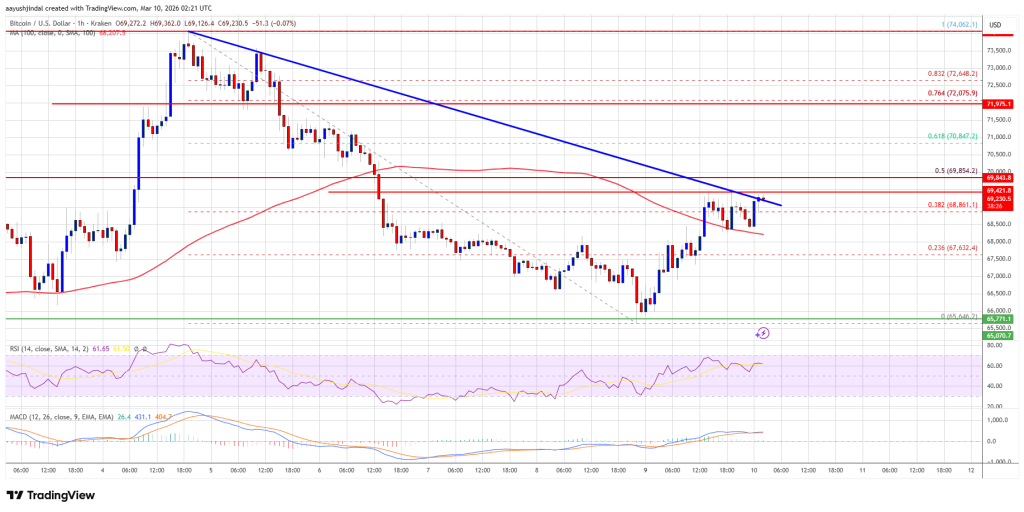


Bitcoin continues to trade below the $70,000 level as the broader crypto market navigates another period of heightened volatility. After several attempts to regain upward momentum, price action has remained unstable, reflecting ongoing uncertainty across global financial markets. Despite these short-term fluctuations, structural indicators suggest that bigger changes may be occurring beneath the surface of the Bitcoin market.
A recent report from CryptoQuant highlights a long-term trend that has been unfolding since 2022: a steady decline in the amount of BTC held on centralized exchanges. This shift accelerated following the collapse of FTX in November 2022, an event that significantly altered investor behavior across the crypto ecosystem. During that month alone, users withdrew more than 325,000 Bitcoin from exchange reserves, rushing to move their holdings into private custody.
Today, total Bitcoin reserves on exchanges have dropped to levels last seen in 2019, currently sitting at roughly 2.7 million BTC. Among retail-focused centralized exchanges, Binance alone holds approximately 20% of that supply, reflecting its dominant role in global crypto trading .
When institutional platforms are included, Coinbase Advanced emerges as the largest holder, with around 800,000 BTC stored on the exchange. Even so, this figure remains roughly 200,000 BTC lower than the levels recorded in July 2025, underscoring the continued reduction in exchange-held supply.
Institutional Accumulation Reshapes Bitcoin Supply Dynamics
The CryptoQuant report also notes that the decline in exchange reserves cannot be explained solely by the aftermath of the FTX collapse. While that event accelerated the movement of funds into self-custody, two additional structural developments have played a major role in pushing exchange balances back to levels last seen in 2019.

The first major driver has been the launch of spot Bitcoin ETFs in January 2024. At the time, exchange reserves were still above 3.2 million BTC. Since then, these investment vehicles have absorbed a significant portion of the circulating supply.
Today, spot ETFs collectively hold around 1.3 million BTC, representing roughly 6.7% of the total supply. Custodial cold storage sequestering these holdings effectively removes a massive amount of Bitcoin from active exchange liquidity.
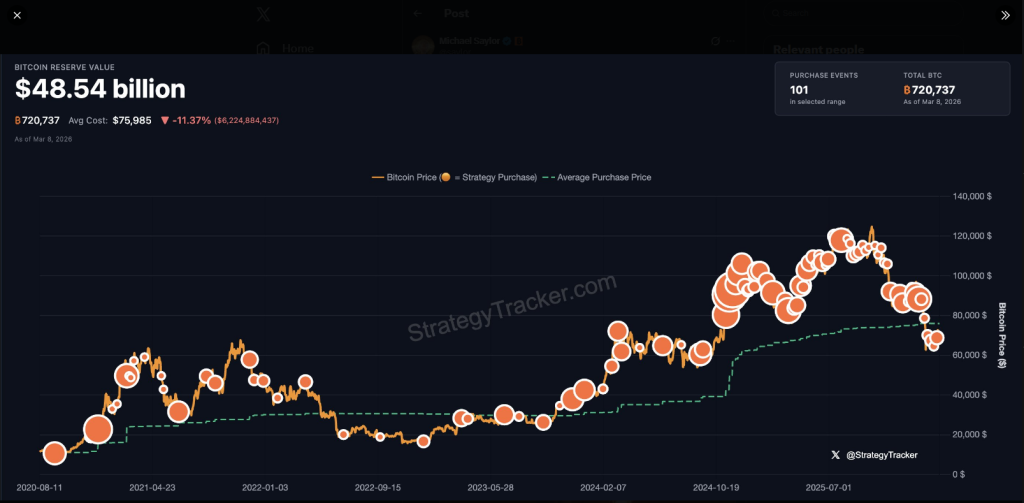
A second structural factor is the emergence of Digital Asset Treasuries. An increasing number of companies have begun holding Bitcoin as a strategic reserve asset, collectively accumulating approximately 1.1 million BTC—close to 5% of total supply.
Together, these developments are reshaping Bitcoin’s market structure. As ETFs and corporate treasuries lock up larger portions of supply, a growing share of BTC becomes embedded within institutional financial frameworks. Over time, this shift could gradually tighten available market liquidity and influence long-term price formation dynamics.
Bitcoin Consolidates Near $67K As Short-Term Momentum Weakens
The 4-hour chart shows Bitcoin trading around $67,500 after a period of sharp volatility that unfolded throughout February and early March. Price initially declined from the $87,000 region, triggering a strong sell-off that pushed BTC briefly below $60,000 before buyers stepped in to stabilize the market. Since that capitulation event, Bitcoin has entered a broad consolidation phase, fluctuating mostly between $64,000 and $72,000.

Technically, the chart highlights a weakening short-term structure. Bitcoin remains below the longer-term moving averages, with the 200-period moving average (red) trending downward and acting as overhead resistance. Each recent rally attempt has struggled to sustain momentum once price approaches this level, suggesting that sellers remain active during upward moves.
Meanwhile, the shorter moving averages have begun to flatten, reflecting a temporary balance between buyers and sellers. The market is currently hovering around these shorter-term indicators, indicating indecision as participants reassess the broader macro environment.
Volume activity remains relatively moderate compared with the spike seen during the February capitulation, suggesting that the most aggressive selling pressure may have already occurred. However, for a stronger bullish recovery to develop, Bitcoin would likely need to reclaim the $70,000–$72,000 zone and establish sustained trading above the descending longer-term average.
Featured image from ChatGPT, chart from TradingView.com